Nature Blog Network
Showing posts with label Invert Porn. Show all posts

Thursday, April 23, 2009

Happy Earthworm Day!

In case you didn't know, today has been declared International Earthworm Day!

Of course it's a great invert to choose for it's own day. Aside from Barnacles (we all know how wonderful they are) and evolution, nothing seemed to occupy Darwin's curiosity as much as earthworms. For over three decades he studied them, off and on, and wrote papers and books about them and their effects in the soil.

Unfortunately today is a chock-a-block, with end of semester work and a seminar tonight so I doubt I'll be able to put together anything new. But here a link to all our past earthworm ramblings here and of course...

Earthworm Porn by a true friend of the invertebrates Isabella Rossellini.

Monday, March 30, 2009

Squidilicious

Night diving, squid and reproduction...
what a combination! Be sure to read Miriam's writeup for all the details.

These two dives were 21 days apart, one from early March the other late March, notice any differences?

From the Night of March 7th:

Squid Spawning Grounds Off La Jolla from Gary Hawkins on Vimeo.

From the night of March 28th:

Squidilicious from Gary Hawkins on Vimeo.

Tuesday, November 11, 2008

Palau Flatworm in HD

Earth-Touch.com is a great resource for some high-def invert video.
This video below is a small, re-sized sample of a really nice longer 720p video from one of the Japanese ships sunk at Palau. Many inverts in the video, but the marine flatworm, coolest of the Platyhelminthes (to my untrained eye, I believe it is Maritigrella crozierae) is my favorite from the whole clip. (The narrator speaks of two of them, in a bit of invert porn, but I only see one in the video... is it just me?)

Monday, October 13, 2008

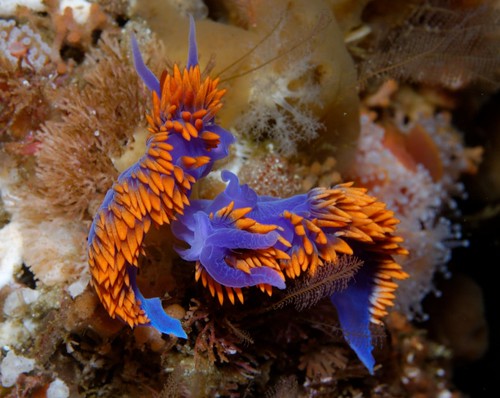
Post-Coital Nudi Love

In lieu of a full quasi-informational posting while I prep for mid-terms I offer....

Mollusc Porn!


thinking of last summer, originally uploaded by dphershman.

Give us your best caption idea for this pair of Nudies in the comments below!

Saturday, September 27, 2008

Sea Squirt Sperm Races


Botrylloides and Botryllus, originally uploaded by top.down.

Miriam at the Oysters Garter has an hilarious and informative post up about a quite serious subject, sperm size and reproductive success in broadcast spawners. Yes, size does matter! So does speed and quantity and...

The image above is from a researcher where I work study showing Botrylloides and Botryllus species of Urochordata. While neither Botrylloides nor Botryllus are endangered, (the topic of this weeks Life Photo Meme) these invasive colonial tunicates are endangering other benthic organisms. Of course the urochordata sexual habits have been discussed here before...

Classification for Botryllus schlosseri

Kingdom
Animalia

Phylum
Chordata

Subphylum
Urochordata

Class
Ascidiacea

Order
Pleurogona

Family
Botryllidae

Genus
Botryllus

Species
Botryllus schlosseri

Friday, September 19, 2008

Locust Love

I was cruising the BBC Motion Gallery web site for some clips and I came across this one of locust love.

Monday, July 21, 2008

Live Nude Bugs!!


Click on photo for more information. Hat tip to iSpiders, also more from Bug Girl here and here.

Wednesday, July 16, 2008

Insect Ejaculate Attracts Parasites x2

ResearchBlogging.orgKevin and I have been anxiously waiting for PNAS to release this one, since we saw it in Nature

A few years ago a Nature Brief Communication described the interesting relationship between the cabbage white butterfly (Pieris brassicae) and the parasitic wasp Trichogramma brassicae. The wasp parasitizes the eggs of the butterfly laid on plants of the cabbage family. The wasp, when given the choice between virgin or mated cabbage white butterfly females, was able to detect and showed a strong preference for the mated females. The authors determined that the wasps used a chemical cue to detect whether the butterfly was virgin or recently mated. The fact that the wasps also chose male butterflies over virgin females gave the team the clue to the source of the chemical cue — the male ejaculate.

The male cabbage white butterflies semen carries a compound, benzyl cyanide, which acts as an anti-aphrodisiac on the females, making them less attractive to other males. The benzyl cyanide turns out to be a component of the male body odor as well. The team tested the compound as the signaling cue for the wasp and found that virgin females treated with benzyl cyanide applied to their wings attracted wasps as strongly as mated females. The same compound the males use to increase the chance of their reproductive success has been co-opted by the wasp as an attractant to hitch a ride on gravid females to the site of egg laying, thus significantly increasing the chance of egg parasitization.


Mated female Pieris brassicae with Trichogramma brassicae wasp (about 0.5mm long) hitching a ride on it's leg.


Additional research from the team published in the Entomologia Experimentalis et Applicata in 2005 indicated that oviposition of eggs by the cabbage white butterfly cause chemical changes in the host plant leaf surface, which cause parasitic wasps to linger. However, the effect was only observed three days after the female had laid a clutch of eggs on the brussel sprout plant, when the host eggs are most suitable for parasitism.

Not only does the male butterfly semen directly attract the wasps, but the benzyl cyanide, which is in the semen as an anti-aphrodesiac, is detectable in mated females' accessory gland secretions. Even when the butterfly does not bring the wasp along, it turns out the benzyl cyanide still increases the chance of the eggs becoming parasitized. While the Nature brief communication described the direct attraction of the wasp to the mated butterfly, the groups newest study published this week at PNAS (in early release) by the same team of researchers has expanded on the effects of the male ejaculate as an attractant to the parasitic wasp. This time there is a third participant in the relationship — the Brussel Sprout plant(Brassica oleracea var. gemmifera), for which the benzyl cyanide pheromone initiates the plants defenses.

The team of researchers found that the secretions of mated females caused parasitoid wasps (T. brassicae again) to linger on treated sections of leaf, but the attraction effect was time dependent, with no effect at 24 hours and a strong effect after 72 hours. They isolated the amount of benzyl cyanide in the secretions, then tested the effect of the benzyl cyanide in solution at a similar concentration (1ng), as well as much stronger (100ng and 20µg) concentrations. After 72 hours they found, once again, it was the benzyl cyanide from the males' semen that was the cause, with significant results at 100 and 1ng concentrations and no significant reaction to the 20µg concentration. The research found oviposition and benzyl cyanide induced changes in the plants were strongly correlated and they believe several of the transcriptional changes in the leaf surface, caused by the benzyl cyanide in the semen, are responsible for causing the wasp to linger on the leaf.


Pieris brassicae egg clutch on cabbage plant (left) and Trichogramma brassicae wasp (about 0.5mm long) on P. brassicae egg.


So the male P. brassicae semen fertilizes the eggs, gives nutrients to the female, causes the female to be more unattractive to other males, causes parasitic wasps to be attracted to the mated females and egg clutches, and causes the wasps to linger on the leaves of the plants which eggs are laid on, but only after 72 hours. What a cocktail that is! It seems that for the cabbage white butterfly this anti-aphrodisiac carries a very high cost indeed.

I wonder what new twists can come next from this research line!?

Literature Cited:


Fatouros, N.E., Bukovinszkine'Kiss, G., Kalkers, L.A., Gamborena, R.S., Dicke, M., Hilker, M. (2005). Oviposition-induced plant cues: do they arrest Trichogramma wasps during host location?. Entomologia Experimentalis et Applicata, 115(1), 207-215. DOI: 10.1111/j.1570-7458.2005.00245.x

Fatouros, N.E., Huigens, M.E., van Loon, J.J., Dicke, M., Hilker, M. (2005). Chemical communication: Butterfly anti-aphrodisiac lures parasitic wasps. Nature, 433(7027), 704-704. DOI: 10.1038/433704a

Fatouros, N.E., Broekgaarden, C., Bukovinszkine'Kiss, G., van Loon, J.J., Mumm, R., Huigens, M.E., Dicke, M., Hilker, M. (2008). Male-derived butterfly anti-aphrodisiac mediates induced indirect plant defense. Proceedings of the National Academy of Sciences DOI: 10.1073/pnas.0707809105

Monday, June 30, 2008

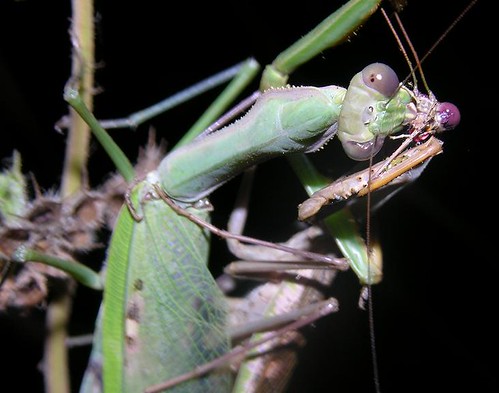
Dinner Mate?


Male's fate, originally uploaded by artour_a.

The ultimate urge - to reproduce and pass on our genes. For some however, it is a fatal desire?

Here a female Polyspilota sp. mantis from Madagascar is chewing off the head of a male while mating with him.

So from some of the experts in the crowd...

What evolutionary advantage is there in the death of the male?
Less resource competition (mating and future competition with the young for food)?
Elimination of a potential predator of the young?

(Thanks to artour_a at flickr for the excellent photo!)

Wednesday, June 11, 2008

Flamboyant Sex and Hot Moths!

Since the Daisy Hill Cuttle Farm video of flamboyant cuttlefish mating is currently unavailable (Though Dorid saved the day with some good voyeuristic vids from her personal collection!) I thought I should endeavor to find some good cuttle porn. This cephalopod sex clip is from a longer piece available at YouTube. The rest of the piece is good, but it's mostly vertebrates teasing and eating each other. As a bonus the video has egg masses and cuttles hatching.


Zooilogix has some amazing moth pictures (and one butterfly) from Igor Siwanowicz. Simply Stunning.

Saturday, June 7, 2008

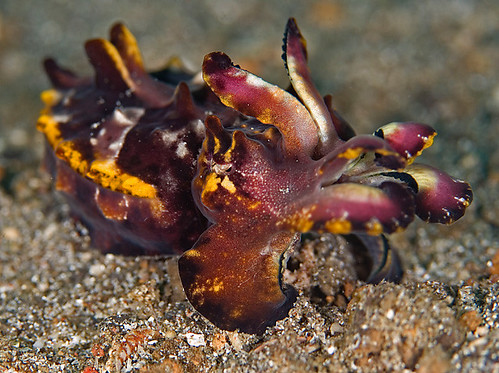
Saturday Spineless Spotlight #1


flambouyant cuttle 3510, originally uploaded by bversteegh.

The flamboyant cuttlefish (Metasepia pfefferi) is one of the other known poisonous cephalopods1. A tiny cuttlefish, adults are only known to reach ~8cm. They inhabit relatively "shallow" waters (<80m) in a very limited geographic range around Indonesia and northernmost Australia. They have been found primarily on mud flats and coral rubble areas. The name flamboyant comes from the purple, pink white, yellow and black colors it displays in ripples when disturbed. The colors are believed to a warning to potential predators of the flamboyants toxicity. They hunt during the day, walking across the ocean floor on their arms and using two flaps of their mantle. Known prey include small crustaceans (shrimp especially) and fish. They mate head to head, after which the female deposits the fertilized eggs in rock and coral caves or in coconut shells, but does not brood them. Like many cephalopods, after mating the adults soon die. The type specimen was collected in 1874 and is now part of The Natural History Museum of London collection.

Daisy Hill Cuttle Farm has some excellent video of a specimen they received from an aquarium display. These cuttles have not been successfully raised in captivity and are NOT recommended for home aquaria.


Check out the rest of the Daisy Hill Cuttlefish video's (warning they also have hard core cuttle porn!)

(edit: If Daisy Hill's Cuttle Porn is down... Dorid has offered us her own home video cuttle sex shots. Thanks for sharing Dorid!)

Kingdom
Animalia

Phylum
Mollusca

Class
Cephalopoda

Order
Sepiida

Family
Sepiidae

Genus
Metasepia

Species
Metasepia pfefferi


1 - http://www.tonmo.com/forums/archive/index.php/t-9570.html Has this been published yet??

Wednesday, April 9, 2008

Hardscore Snail Porn: Click only if You Are 18 or Over

Snail porn the first half and amazing invert footage the other half, including larvae breaking out of and eating its egg case and a spider snatching and eating a grasshopper. Sexy Boy by Air certainly sets the mood for the snail sex scene! Footage from Microcosmos.

Friday, April 4, 2008

The Cephalopod Dating Game

I thought I would take a few minutes for a quick post as a way of hello and to say "Thanks Kevin!" But then I thought, I might as well start off on the right foot* with some cephalopod love. 


The recent  Abdopus aculeatus mating paper by Huffard et al. has been covered already in other quarters, and I won't rehash their coverage or the original press release, but there is new video available to go with it from two different sources, which I think is enough of an excuse for me to throw together a quick post highlighting not only this study but some of the other cool work Christine and her colleagues did on this species. But first the video...


A distinctly different video with Roy Caldwell narrating can be found on the Associated Press video site. Unfortunately they don't provide embedable video, but it's well worth the click (and waiting through their 15-30 second advert video).

Christine Huffard is now a Postdoc at MBARI and did her thesis on Abdopus aculeatus behavior and locomotion.  In the paper that was recently published online in Marine Biology, she and her colleagues described the complex mating behaviors of this species, information gleaned through over 790 hours of observation in the wild. Much has already been mentioned of the sneaker males,  males guarding female burrows, male aggression towards competitors, males ripping and tearing each other's hectocotylus arms (OUCH!).  

One thing I find especially interesting is that many of the behaviors noted in their study of this octopus have been noted in one or more species of squid or cuttlefish before. As the authors report, this species of octopus does not show any reason to be especially unique in mating behavior either, suggesting that other species of octopus may have similar behavior that has not yet been observed. 

In their 1996 book Cephalopod Behavior, Hanlon and Messenger were careful to point out that there were not many studies to base the chapter on, and especially lament the lack of knowledge in oceanic squid mating behavior.  Mating behavior in cephalopods was at that time represented primarily by a select few species: 15 species of squid, with only two well studied, 9 species of cuttlefish, again with only two species well studied, and 16 species of octopuses with laboratory studies of Octopus vulgaris comprising the bulk of the observations. Octopuses were viewed as solitary animals and octopus mating was interpreted as the last major act in life and one without any ritual or selectivity, or as Boyle and Rodhouse summarized in Cephalopods: Ecology and Fisheries -
Mating takes place with few preliminaries in octopuses, but in cuttlefish and loliginid squid , elaborate courtship behaviors have been described.
In the intervening 12 years many discoveries have changed the way cephalopod mating and subsequent parental care is understood, or at least viewed. Hunt and Seibel showed that Gonatus onyx, in contrast to all other known squid species, broods its eggs, caring for them for over a year before they hatched as the female literally wastes away, metabolizing her own muscles to stay alive.  Recent research by Hanlon et al. published in 2005 suggests that at least in one species of cuttlefish, Sepia apama, the females may "reward" sneaker males by choosing their spermatophores as the ones used to fertilize the eggs. Interestingly, the Huffard paper found that the length of single copulation time for a sneaker male was twice as long as for a guarding or transient male. So finally, we find an octopus species with what would traditionally be known as squid and cuttlefish-like agonistic behavior, complex mating rituals, guarding behavior and sneak attack/sexual mimicry. In just a dozen years, octopus mating has gone from a boring, post-climactic act to spicy, complex, and even intimate.

With hints of similar behavior in other octopus species (Octopus cyanea), there is now even more need to get some significant observation time in on at least the shallow water species. Christine and her colleague put in 790 animal observation hours watching 167 individuals(!!). Aside from the cephalopods, this study had the video technology working with video data recording, video analysis and illustrations pulled from video.  For me, adding in some diving (they had no need, as it was snorkel accessible intertidal areas) would make it a perfect study.


References:

Huffard et al. Mating behavior of Abdopus aculeatus (d’Orbigny 1834) (Cephalopoda: Octopodidae) in the wild. Marine Biology (2008). Published online: 23 February 2008. 

Boyle, P.R.,  and P.G. Rodhouse. 2005. Cephalopods: Ecology and Fisheries. Blackwell, Oxford, UK

Hanlon et al. Transient sexual mimicry leads to fertilization. Nature (2005) vol. 433 pp. 212 

Hanlon, R.T. and J.B. Messenger. 1996. Cephalopod behavior. Cambridge University Press, New York, New York, USA.

*Huffard et al. Underwater Bipedal Locomotion by Octopuses in Disguise. Science (2005) vol. 307 pp. 1927.

Hunt, J.C. and B.A. Seibel. Life history of Gonatus onyx (Cephalopoda: Teuthoidea): ontogenetic changes in habitat, behavior and physiology. Marine Biology (2000) vol. 136 pp. 543-552.

Friday, December 21, 2007

Sea Squirts, SLOSS and of Course Porn

Blogging on Peer-Reviewed ResearchCastilla et al. (2007) are reporting in a recent PNAS article an interesting property of sea squirt pornography and local oceanography. I know, I'm a frequent purveyor of tunicate smut, but this utter filth may have consequences in the debates surrounding marine reserve design. These authors studied the spawning behavior of intertidal tunicates (Pyura praeputialis, an invasive) from chilean coasts. What they found will make all decent folk turn their insides out. These filthy denizens of the seas let it all out together in a mass orgy. Oh the indecency. Are you sure the children are asleep and not watching over your shoulder? You may want to tuck them in before continuing on.

Sea squirts have mobile "tadpole"-like larvae whose role is typically dispersal since they do not feed. The also don't stay in the water column for too long, preferring to stick their heads to a rock somewhere (figure below shows larval metamorphosis).


So what happens when tunicate sperm and egg meet seawater? An explosion of bio-foam! This foam is created by surfactants in Pyura's gametes (see figure below). This reduces the surface tension of the seawater. So basically, sea squirts spawn en masse, the high amount of gametes in tidal channels releases a high amount of surfactants which react with the seawater and its associated protein debris creating foam, the surface tension is reduced so larvae are not carried out to sea, thus larvae are retained in the tidal channel! As simple as that. Castilla et al. (2007) document the effects this foam might have on larval dispersal ability by monitoring ping pong balls in the channels. When there is no foam present, they all head out the channels to sea. When foam is present, 50-60% of the ping pong balls were retained in the tidal channel (depending on ebb or flood tidal conditions).

A) Mass splooging of P. praeputialis. B) Sperm (SS) and egg (ES) suspensions left dripping in the intertidal. C) 2 meters of foamy splooge. D) Chilean researcher knee-high in sea "squirt" if you know what I mean... Fig. 1 from Castilla et al. (2007).

So what is the end result of this filthy, spineless mass bukkake? (That ought to bring in the hits!) Larvae are retained in the tidal channels resulting in massive colonies over several generations. They are not trapped here though since theoretically, as shown with the ping pong ball experiment, nearly half of the larvae escape out to sea where they can start new colonies in other tidal channels perhaps. But this suggests that other larval forms are also retained during foamy times. Hence this bio-foam acts as resistor to the current of larvae out of a particular channel.

This has some interesting connotations for the ever debatable Single Large Or Several Small (SLOSS) dilemma facing marine reserve designers. If rare or endangered species occur in such tidal channels, for instance, you would want to grant protection to that channel. It is acting as quasi-reservoir for recruitments. Populations would appear to build up in these channels (excluding all other ecological forces that determine population size like competition, resource availability, etc.) and proportionally send out more larvae with each generation. This research suggests that protecting individually foamy channels (those with gametes secreting surfactants, or channels with high protein debris content) would more sufficiently protect the potential source of larvae for a particular species of interest. You just need to find the right areas, the foamy ones.

Of course this opens up a lot of questions. As someone interested in communities and diversity. I would like to understand how surface tension reduction affects the structure and composition of communities in foamy channels and compare that to non-foamy channels. Or, how planktonic communities respond to this potential stress? Does the composition of the seston track the cyclic patterns of the foam production and tides? Is diversity higher in non-foamy channels because foamy ones tend to have a higher dominance (and lower evenness) of a few species like Pyura praeputialis. Does the foam and reduced surface tension, act a barrier to immigration for new species and recruits? Its a pretty interesting system and though I don't know the foam literature well, I get a sense that this isn't well-studied. I will be looking for a postdoc very soon.... (hint hint).
____________________________________________________________________
Castilla JC, Manriquez PH, Delgado AP, Gargallo L, Leiva A, Radic D (2007) Bio-foam enhances larval retention in a free-spawning marine tunicate. Proceedings of the National Academy of Sciences 104:18120-18122. doi:10.1073/pnas.0708233104

Thursday, October 4, 2007

Circus of the Spineless


The Annotated Budak has the 25th edition of the Circus of the Spineless. I must say that his writing up of all the submissions was captivating and certainly made my post on ant-mimicking spiders more appealing than I ever could! Just to read his poetic wording of the posts is reason enough to head over. The fact that its the Circus of the Spineless, which highlights the last months invertebrate postings... well, I am ashamed you are still reading this!

They are so great but here are three I really liked:
Bad Day for a Beetle at the Annotated Budak
Painted Jezebel: Distasteful to birds? at the Bird Ecology Study Group (Singapore)
That Crab Has Flies at Evolgen

I leave you with this totally awesome photo submitted by Jennifer Forman Orth of the Invasive Species Weblog.

Wednesday, September 19, 2007

Ant? Spider? You Decide!

During the course of my blogging here, I have become somewhat of a fan of spiders. My previous posts on spiders have focused on their unusual characteristics, such as doing the booty drop, showing off a little bling bling to catch the ladies eye, cutting off a leg to escape predators, and checking their web stats. I have developed an appreciation of spider diversity and behavior through reading papers that have caught my attention for this blog.

One of the reasons I absolutely adore the theory of evolution is that its predictive power can be so wonderful. The results of selection so wondrous in and of themselves. I am familiar with many aspects of symbiosis, having co-taught a class on the subject with my advisor (I covered mammalian herbivore digestion, termites, wood-eating bivalves, and bioluminescence) and working on the ecology of animals with chemoautotrophic bacterial endosymbionts for my dissertation research. I have seen alot of strange and unusual adaptations, but they just keep getting stranger and stranger the more I delve into the fantastic world of evolution and behavior. With this I now bring you the word of the week:

Myrmecomorphic
Its a fantastic word brought to my attention by a recent paper published in the Journal of Natural History by Nelson & Jackson. What does this word mean? The root words "myrm", "eco", and "morphic" refer to ant, home(Aydin suggests eco may derive from echo meaning repeating, which makes more sense than deriving from oiko meaning home) and form respectively. Hence this refers to species that are an "ant-repeating form".As Christopher from the Catalogue mentions in the comments below, the most plausible definition is from the roots myrmeco- (derived from myrmex, "ant") and morphic ("form"), meaning ant-form or ant-like.


Top photo by Sean Hoyland and bottom photo courtesy Sandilya Theuerkauf, Wynaad, 2006, both from Wikipedia Commons.

This is a form of Batesian mimicry, which is between 2 different species that look very similar. The caveat is that one species is usually toxic, spiny or otherwise not very pleasant to eat, while the mimic is typically a fraud in the arena of danger. In the two photos above did you spot the real ant? If you count the legs its easy to tell. The individual in the top photo has 8 legs whereas the bottom photo is the Weaver Ant, Oecophylla smaragdina, the queen nonetheless. The mimic is Myrmarachne plataleoides (female shown in photo, males have gigantic mandibles, about 33% of their body length).

The spider genus Myrmarachne (Salticidae - the jumping spiders) is characterized by these fraudulent mimics with nearly 200 species of ant wannabes.
Ants are dangerous and unpalatable prey-size organisms and a variety of would-be predators of salticids, including other salticids and mantises, avoid making predatory attacks on, or coming close to, ants. Experimental studies have also shown that salticids and mantises that are averse to attacking ants are averse to attacking Myrmarachne"-Nelson & Jackson 2007

Top: Oecophylla smaragdina, Bottom: ant wannabe Myrmarachne plataleoides (female). Photos copyright Chih Fah Shin

As I've shown with other jumping spider posts (see links in first paragraph) they have quite complex mating behavior. Nelson & Jackson describe in detail the mating behavior of Myrmarachne assimilisand M. bakeri. Its quite the romance novel. Visualize a hot steamy jungle next to a white sand beach, a gentle breeze, seagulls laughing in the distance...

He's alone, walking through the brush and then he sees her. The morning dew glistening off her abdomen. Her four eyes catching the sunrise to the east. He arches his palp and twitches his abdomen, standing erect. She faces him, waves her palps in their air as he watches with anticipation. She turns away, he follows, she turns around, he waits. Her cephalothorax lowers, he dances in response, she lunges past him, yet is blocked by his desire. Eight eyes are staring. She tries to leave, but his approach beckons her. His legs erect, they brush up against her legs. She wants to run away, escape from these feelings, yet can't seem to pull away. The power of lust overcomes all her senses. She shifts her abdomen closer, he gently places his chelicerae upon her abdomen. Softly, calmly, he applies each palp once, then its over.
"When the male disengaged his applied palp, he moved over the female (her abdomen no longer raised or rotated), tapped and stroked and then, once positioned again beside the female, the male scraped his palp across her now flexed-up and rotated abdomen and resumed copulation. Before next palp application, while centered over the female, the male sometimes stepped backwards and forwards, stroking and tapping intermittently."-Nelson & Jackson 2007

Friday, September 7, 2007

Revelations: How My Readers Are Finding Me

I like Statcounter. Its a very useful, free counter that tells me lots of interesting things about the people that come to my site. One of these interesting things is that I can see what websites people come here from and what keywords people use to find my site on a search engine. As you all know I wrote a post on the promiscuity of a certain sea squirt titled Sea Squirt Chics Have No Inhibitions. Which also inspired my one hit wonder Sea Squirts Just Want to Have Fun. I have been getting some, not a whole lot, but more than a few hits a week to my website by people searching "squirting chics" or variants of those two words.

Click to enlarge


I find this highly revealing about my readers. I'm not quite sure what to make of my website being listed alongside "Ejaculating Women Videos", a "How to squirt loads" forum, femaleorgasmsrevealed.com, etc. I guess sex sells right? So am I just another purveyor of perverted invertebrate pornography?

Saturday, September 1, 2007

One Snail Species Prefers to Do It Anti-Chiral

Most snails walk the line and stick with doing the dirty deed missionary-style. No one even thinks about any of that kinky, low-down, unholy ways of propagating the world. But Schilthuizen et al. 2007 report in the latest Journal of Evolutionary Biology (open access!) that one disgusting species of snail actually selects for anti-chiral mates (Fig. 3b, d to the right reproduced under the Creative Commons Deed, Attribution 2.5). This scandalous sixty-nine of satan is even sexually selected for by spermatophore morphology! Just when I thought I heard it all.

Chirality in snails refers to what directions the coils run, clockwise or anti-clockwise (known as counter-clockwise in some localities).

"The cause of directional asymmetry is clear in only a few groups (Vermeij, 1975), such as in gastropods (snails). Their coiling direction (not only of the shell but also of the entire body organization), determined by a single locus of maternal effect, is usually fixed within a species because mating among D and S individuals (so-called ‘inter-chiral mating’) is either impossible or very difficult. Consequently, a rare reverse-coiled morph will normally not persist because of frequency-dependent selection."-Schilthuizen et al. 2007 (references removed)
So typically is a pretty rare thing and it usually dies out of the population fairly quickly. But not satisfied with being a typical gastropod, members of the southeast asian tree snail genus Amphidromus do NOT, yes I repeat do NOT, deviate from a 1:1 ratio of dextral (right-opening) to sinistral (evilleft-opening) individuals. They keep their damned "whole-body chiral dimorphism", but why would a snail do such a thing? Schilthuizen et al. 2007 proposed a series of hypotheses that they tested:
1) Frequency-dependent selection countered by extrinsic balancing selection. Basically, one morph is present in higher number and is predated upon unto rare than other morph which is then, in turn predated on, etc.
2) Occupy separate niches
3) Dimorphism is maintained by intrinsic factors such as coiling genetics or reproduction.

They observed 2 separate populations of Amphidromus inversus, with the same predation frequency. Though the dextral morph was slightly less than 50% (~35%) of the population, predation was the same hence hypothesis 1 can be ruled out (i.e. no increase in predation frequency with the more frequent evilsinistral morph). Additionally, a PCA analysis using 10 biometric features shows there is no difference between D and S morphs. They are in fact mirror images of each other, which suggests to the authors that they are ecologically equivalent. They provide other evidence from previous work led by the first author that both morphs have identical dispersal patterns, habitat preference, and molecular data shows they are panmictic to argue against hypothesis 2.

Which brings us to hypothesis 3. To study inheritance of chirality, they grabbed all the egg bunches they could and waited till the juveniles hatched out (Fig 3f to the left, reproduced under the Creative Commons Deed, Attribution 2.5). Except for one clutch, all other clutches were invariant for coiling direction. In other snails, coiling direction has been found to be maternally transmitted from a single locus, which the data fro this study onA. inversus is consistent with. Still waiting for the cool part?? See below.

Fig. 5 reproduced in its beautiful entirety under the... you get the drift. These pictures are of the spermatophore. Important to note the spiral tip.


Oh yeah, thats one mighty spermatophore, 60mm schlong that curves either to the right or the left. This curvature reflects the chirality of the shell.
"The oviduct is connected with the SRO [spermatophore receiving organ] at an angle to the left or to the right in a sinistral or a dextral recipient, respectively, whereas the spermatophore tail tip points to the left or right in a dextral or a sinistral donor respectively (viewed from the front of the recipient animal). Consequently, it can enter the oviduct more easily in inter- than in intra-chiral copulation (Fig. 5e–h)."-Schilthuizen et al. 2007, italics my own.
Its all about the fit not the size... So what's the conclusion? Why do I think this is a cool study?
"we have shown that mutual mate choice for a partner with mirror-image asymmetry stabilizes antisymmetry in these snails. As far as we are aware, this is the first confirmed case of heritable antisymmetry in the Metazoa."-Schilthuizen et al. 2007

Thursday, August 9, 2007

Spineless Song of the Week - Sea Squirts Just Want To Have Fun

Photo of Clavelina dellavallei from Mer et Littoral - La Flore et la Fauna Marine l'Atlantique et de la Méditerranée


Inspired by recent research by Johnson & Yund that I posted on here, I transformed a classic Cyndi Lauper song into a Urochordata masterpiece. Well, thats for you to decide. If you don't know the song this is sung to, step out of the cave... Liquid courage brought to you this week by Dale's Pale Ale from the Oskar Blues Brewing Company.

Sea Squirts Just Want To Have Fun

I’m attached to rock in the moonlight
My colony says 'when you gonna live your life right?'
Oh but females aren’t the fortunate ones
And sea squirts, they want to have fun
Oh sea squirts just want to have fun

One sperm come in the middle of the night
My colony yells 'what you gonna do with your life?'
Oh ascidians, I can’t have only one,
But sea squirts, they want to have fun,
Oh sea squirts just want to have

(Chorus)
That's all they really want...
some fun...
When the filter-feeding day is done
Oh sea squirts they want to have fun
Oh sea squirts just want to have fun

Many males enter my siphonal canal
I don’t care how many, I’ve got eggs for them all
Some may say I’m too promiscuous
But sea squirts just want to have fun
Oh sea squirts just want to have

repeat chorus

Jumping Spiders, aka Nature Pimps, Officially Named Sexiest Invertebrate of the Animal Kingdom

Not only do jumping spiders "drop it like its hot" to impress the hotties on the dance floor. Asian jumping spiders, not to be outdone by counterparts elsewhere in the world, flash a little bling bling to catch the ladies' eye. Taylor & McGraw report in the latest Current biology, that three-layered "scale sandwiches" of chitin and air produce a brilliant iridescent display that simply irresistible (photo to left, from Taylor & McGraw).

Only the scales of males reflect UV-light which the females can see, though humans being so intelligently designed cannot. When viewing a mirror image of themselves,

"males displayed aggressively to their mirror image, as we would expect one to behave towards a rival male; however, when UV light was filtered out, the males behaved differently, often courting themselves."-Taylor & McGraw 2007
They are so sexy even they can't keep their chelipeds off themselves!
"Females also seem to be paying attention to UV coloration in males; in experiments where UV light was filtered out, females ignored male courtship displays."-Taylor & McGraw 2007
Chica-chica bomp bomp oh yeah. Bang a gong and get it on.

Apparently, some really nerdy humans studied their scales and found that
"...each scale is composed of a sandwich structure with two outer corrugated chitin plates surrounding a thin layer of air (Figure 1C). This structure functions as a multilayer reflector, whereby the alternating layers of chitin, with a high refractive index, and air, with a low refractive index, organized at just the right periodicity with respect to the wavelength of light reflected, result in constructive interference, as light reflected off each interface emerges in phase"-Taylor & McGraw 2007
yadda yadda yadda. Whatever. This is just nerdspeak for male jumping spiders are the sexiest invertebrate in the Kingdom. Jumping spiders are so hot, just looking at the image above makes my retina sizzle.