Nature Blog Network
Showing posts with label Arthropoda. Show all posts

Sunday, May 17, 2009

Tiny Friends

We found an ootheca recently, and brought it in to watch the hatching of 85+ tiny (less than 1cm long) mantids. They have now taken up residence in the garden hopefully keeping the early spring aphids at bay.


Johann's newest pet, originally uploaded by eclectic echoes.

Sunday, February 22, 2009

Clearing the Archives #1: Hermit Crabs

I'm trying to clear out my archives of accumulated photos I took over the last year. Most of these were to post on this blog but I was never able to get around to it or just plain ole forgot. I'm horrible when it comes to downloading my photos! So for the next few weeks I will post some of my pictures from my folder aptly titles "Needs to be Sorted". I'll write what I can recall of the photo.

The following hermit crabs were Steph's pets in our office at my former job at Penn State. They are absolutely adorable! I think we had 7 at one time. At least 2 different species. I don't remember what they were anymore. Nick, a grad student doing molecular ecology with corals, dumped off several small ones after snipping a claw from them for genetics. So I guess we were kind of a hermit crab sanctuary/rehabilitation clinic. I think hermit crabs might make the perfect first pet for Elliot. Probably a land crab.


Tuesday, February 17, 2009

Waiting for the Spring


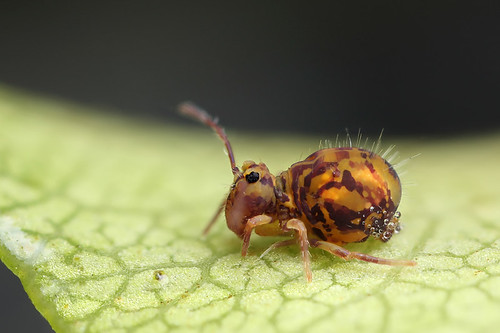
bubble bum springtail, originally uploaded by Lord V.

A wonderful image of Dicyrtomina ornata, a springtail showing the eyes, and if you look carefully under head, the furcula just touching the leaf between the first and second pair of legs.

Wednesday, January 21, 2009

Bring out the Tats Round 1

DSN recently posted Ocean Tattoos from the illustrious Love Lab at UCSC UCSB. Of course mindful of the historic Invertebrate Wars and the recent artful attempts by pro-echinoderm agents to renew the conflicts, I thought maybe a survey of science tattoo subjects could be used as a proxy to head it off.

With that in mind I headed over to Carl Zimmer's science tattoo galleries for a pilot study. I figured out of the 200 or so science tattoo's in his gallery at most a quarter of them were of animals so that would provide a nice sample size I could handle between classes. Sure enough, I ended up with 41 tattoos for which the animal was the subject, and that wasn't of a specific personality (e.g. no Darwin tattoos). I then evaluated each tat for the main subject phylum, except the case of the chordata, where I evaluated as invertebrate chordates and vertebrates (this being an invert centric blog after all)

The score:
Vertebrates: 16
Invertebrate Chordates: 1 (Pikaia)
Arthopoda: 13
Cnidaria : 2
Echinodermata: 2
Lobopodia: 1
Mollusca : 5

For the invertebrate war phyla, I was surprised that both echinoderms and molluscs are so under-represented in the gallery. I may have to get a tat for graduation, and another when I get a masters.

Hopefully the Love Lab won't be so vertebrate skewed...

Hmmm... who belongs to this winning one?
Monday, January 12, 2009

Wild Hoppers!

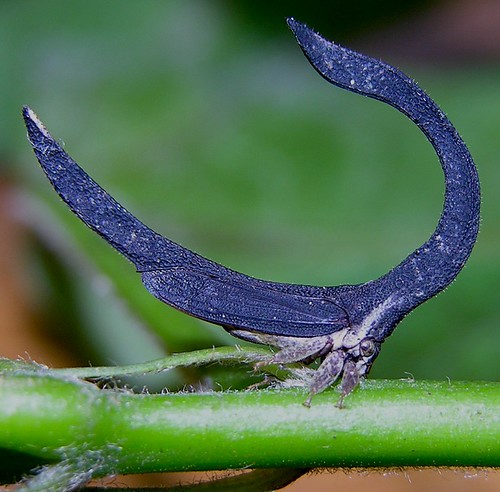
Cruising through a few of the recent images uploaded by Artour_a at Flickr and I ran into this beautiful treehopper. I remember some real oddities when I was in Honduras, but this one is a real winner!

Artour_a has quite a few tropical tree hopper images on his site in a great set called...hmmm. what was it called? Oh, yes - Treehoppers:

Thursday, October 23, 2008

Misunderstood


Sticky Situation, originally uploaded by fiznatty.

For this week's Life Photo, an organism that has gotten quite a bit of press today, but that I fear will only exacerbate the common misunderstanding of it's kind that is prevalent in our society. Above is a beautiful golden silk orb weaver spider of the Genus Nephila. These spiders can grow to be pretty large (for the Nephila clavipes above, up to 40mm long) and love to spin (their genus name means spin lover) beautiful webs often with reinforcement threads in them that zig-zag back and forth looking a bit like a runway for small flying insects to follow to the center. As with many spiders they are not aggressive towards humans and their venom is not toxic. Orb weavers are pan tropical with N. clavipes, reaching into the southern U.S. Heck I really wish we could find them here in Connecticut. Maybe in another 25-30 years.

So what is the news that may exacerbate the misunderstanding of this species?

Welll, it seems that at least one of the Nephila species wanted to see the invert vs. vert series brought back and figured the best way was to show how an real invert can take on a much larger vertebrate:


Of course this is getting much play across the net, most of it remarkably good, but some reactions of fear and loathing.

Classification for the orb weaving spiders

Kingdom
Animalia

Phylum
Arthropoda (crustaceans, insects, spiders & related)

Subphylum
Chelicerata

Class
Arachnida

Order
Araneae (Spiders)

Family
Araneidae (orbweavers)

Genus
Nephila

Saturday, October 11, 2008

Cellar Spiders


Longbodied Cellar Spider
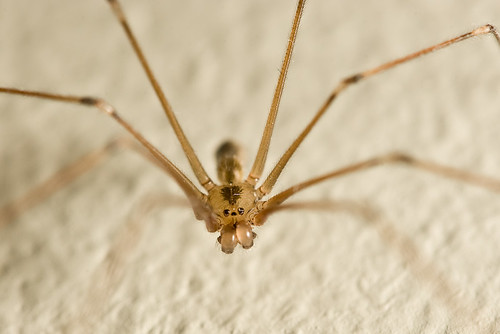
Longbodied Cellar Spider, originally uploaded by eclcticechoes.


When I think of spiders I typically think of either the orb weaver spiders with their beautiful webs or tarantulas and trapdoor spiders that line burrows with layers of silk. Comparatively the cellar spider's web is a downright mess, lines going every which way, no order, random chaotic (hmmm...a bit like my desk!).

The time of year has come in New England for the cellar spiders of the family Pholcidae to show up in the house. A family with some 1000 species and a truly worldwide distribution these spiders are often referred to as "daddy long legs" which Christopher explains is an absolutely useless name since it is applied to many diverse groups of animals including our friends the harvestmen, which Christopher explains is . The one above is the Longbodied Cellar Spider (Pholcus phalangioides). This one was drunkenly admiring the art, but when the paparazzi attacked it decided to take a break from visual arts and engage in some culinary arts hiding behind the recipe books in the kitchen.

I say "drunkenly" since when these spiders walk about on the floor they often bob and weave as if they are one of the late night drunks headed past my house on a Saturday night. Their walk is not the only interesting motion of theirs. If disturbed in their webs they will begin vibrating wildly, seeming to dance. It does make them at times hard to track so I can see where this would work as a defensive maneuver.

Anyone know the meaning of "phalangioides"?

Classification for Ctenocephalides felis

Kingdom
Animalia

Phylum
Arthropoda

Class
Arachnida

Order
Araneae

Family
Pholcidae

Genus
Pholcus

Species
Pholcus phalangioides

Saturday, October 4, 2008

The Ignoble Fleas


I always love closeup shots of the the inverts, great macro shots or SEM's like this one.

Couple that with excellent Ignoble Award winning research such as Marie-Christine Cadiergues, Christel Joubert, and Michel Franc of Ecole Nationale Veterinaire de Toulouse, France who discovered that the fleas that live on a dog can jump higher than the fleas that live on a cat.

M.C. Cadiergues, C. Joubert, and M. Franc (2000) A Comparison of Jump Performances of the Dog Flea, Ctenocephalides canis (Curtis, 1826) and the Cat Flea, Ctenocephalides felis felis (Bouche, 1835). Veterinary Parasitology, vol. 92, no. 3, October 1, 2000, pp. 239-41. DOI: 10.1016/S0304-4017(00)00274-0

Classification for Ctenocephalides felis

Kingdom
Animalia

Phylum
Arthropoda

Class
Insecta

Order
Siphonaptera

Family
Pulicidae

Genus
Ctenocephalides

Species
Ctenocephalides felis

Wednesday, September 3, 2008

Ug. You. Go. Boneyard. Ug. NOW!

Zach at When Pigs Fly Returns has the latest edition of the paleo-carnival, The Boneyard!

Cycleryon sp., image from FossilMall