Nature Blog Network
Showing posts with label Gastropoda. Show all posts

Wednesday, April 29, 2009

Fast Snails


Snails Go west ! Funny TimeLapse from www.time-lapse.fr on Vimeo.

Hat tip to Unique Daily.

“Every evening, after my automatic water system stops, all the snails who where hidden behind flowers go out and go on the grass to make parties, eating and drinking! They move from east to west!”

Tuesday, December 2, 2008

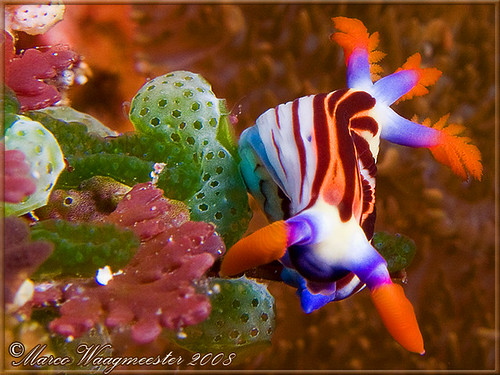
Random Invert Picture - Nembrotha aurea

The photographer id's it as Nembrotha purpureolineata but the orange dorsal patch looks to me more like it is Nembrotha aurea as described in

Marta Pola, J. Lucas Cervera, Terrence M. Gosliner (2008). Revision of the Indo-Pacific genus Nembrotha (Nudibranchia: Dorididae: Polyceridae), with a description of two new species Scientia Marina, 72 (1) DOI: 10.3989/scimar.2008.72n1145

Tuesday, October 21, 2008

From artour_a at flickr.


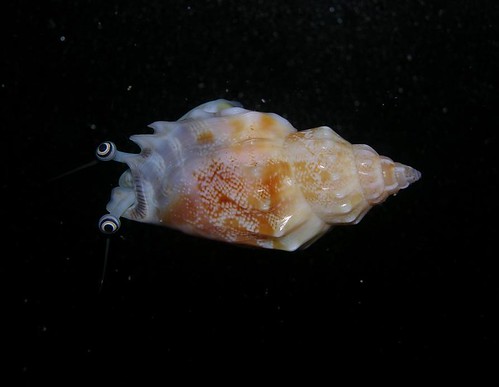
Dumbeye
Originally uploaded by artour_a

Thursday, August 28, 2008

World Snail Racing Championships!


The Telegraph reports:
"Named after Lewis Hamilton's Formula One teammate, Heikki triumphed, leaving his rivals trailing in his slime with a time of three minutes, two seconds.

His owner, 13-year-old Georgie Brown from East Winch, Norfolk, saw him overcome over 200 garden snails battling it out over the 13 inch course in their quest to become World Champion.

The annual event at Congham, near King's Lynn in Norfolk, is over 30 years old, and although there are a number of imitations, it is the only recognised World Championship."

Hat tip to Aydin.

Tuesday, August 5, 2008

Monday, July 21, 2008

I (Heart) Conch

New T-shirt from the Cotton Factory!! This one goes out to Andrew.

Wednesday, July 9, 2008

Friday, May 30, 2008

Freshwater Gastropod Baby Photo


Little Spawn

Little Spawn, originally
uploaded by:
EclecticEchoes

Risking having it look like snail week... but ...

These little fresh water gastropods are from my son's aquarium. I believe that the snail is a Lymnaea sp., but I'm not a freshwater gastropod expert . It is dextral (aperture is on right with the spire pointed and oriented to see the aperture), with a thin shell that has 5-6 whorls (see below). Adults (in our tanks at least) range from 10 to 25mm while the young, fresh hatches, are about 1-2mm. They are pulmonate with no operculum, lay eggs in a gelatinous mass on the under side of broad leaved aquatic plants. The feed mainly on algae and detritus, but will preferentially go after any rotting plant leaves. The tentacles are triangular with eyes at the base. As a pulmonate this snail regularly rises to the surface to refill it's pallial lung.

Lymnae snails are simultaneous hermaphrodites, and from 2 individuals a water body can quickly be colonized. Which is precisely what happened to our larger tank when some snails or eggs made it into our tank attached to some plants. Egg masses have 20-40 individual eggs each which hatch 10-14 days after being laid.

As an informal experiment we placed one single snail in our smallest tank when it was torn down and rebuilt. All previous snails were removed and the tank torn down to bare glass removing all substrate material. Sterile sand and gravel were used as the base, to which plants were added that were wiped down and inspected for snails and egg masses. Fresh water, shrimp and fish were added to the tank and it was allowed to settle for a month, during which time the tank was inspected daily for snails or snail egg masses. After a solid month with no evidence of any snails, an 18mm adult snail was moved from an adjacent tank. Again the tank was inspected daily for snail egg masses and a snail count made. After 45 days there was still only the one introduced snail in the tank. Now (3 months later) there are 50+ snails in the tank: one 18mm adult and 49+ young snails of 2-4 mm lengths.

Sperm sequestration? Self fertilization? Both are reported in Lymnaea so it is hard for me to tell exactly, but no matter which, it does reveal a key trait that these snails use to for survival and to exploit new territory.

CRW_2727

Lymnaea sp. Snail, originally
uploaded by:
EclecticEchoes


Kingdom
Animalia

Phylum
Mollusca

Class
Gastropoda

Order
Pulmonata

Family
Lymnaeidae

Genus
Lymnaeas

Thursday, May 29, 2008

Work With An Invert! - Freshwater Gastropod Systematics

PhD position - molecular systematics and evolution of freshwater gastropods

A three year PhD position is available at the Museum of Natural History Berlin in a research project on the molecular systematics and evolution of viviparid snails. Funding is provided by the Deutsche Forschungsgemeinschaft (DFG).

Viviparids are a species-rich and phenotypically diverse group of freshwater gastropods with an almost worldwide distribution and a long fossil record. We want to use this group to address issues in evolutionary biology such as the evolution of morphological disparity, biogeography or ancient lake radiations. A major component of the project will be the reconstruction of viviparid phylogeny using both molecular and morphological techniques. The geographic focus will be on Asian taxa.

We are seeking a student with a MSc or equivalent degree (diploma) in biology. The successful candidate should have experience with techniques in molecular and/or morphological systematics and should have a strong interest in biogeography and evolutionary biology. Good communication skills, the ability to work independently and the willingness to conduct fieldwork in South and Southeast Asia are essential.

We offer an intellectually stimulating research environment in one of Europe’s largest natural history museums with well-equipped state-of-the-art lab facilities.

To apply, please send an e-mail application including CV, names and addresses of two referees and a brief letter explaining why you are interested in this PhD position by June 20 to Thomas von Rintelen: thomas.rintelen@museum.hu-berlin.de. Please quote the job reference number DR/046/08 in the subject line.

Wednesday, May 28, 2008

Inner City Snails

I love this "slow-moving street art project" from Slinkachu. Go to Inner City Snails for more.

Saturday, May 3, 2008

Conch Farming

Rick MacPherson is in Turks & Caicos for a meeting and is urging us to Honk if we like Conch.

Oh, man, do I love conch!

When I lived in Honduras, I was fortunate enough to get out to Roatan every few weeks for diving, Garifuna music, good food, and relaxation. One of the best parts for me was the near daily serving of conch. Usually it was as conch salad, but I love them in fritters as well. Unfortunately, Honduras Queen Conch are still being heavily fished, even though their numbers have decline very sharply since tourism increased.


Three conch shells
in the mangroves.
Photo ©Eric Heupel

And Belize... During my recent trip to Belize at South Water Cay and Carrie Bow Cay, there were only a handful of live conch to be seen, but hundreds of empty shells. Most of the live individuals were 2-3 years old. This is very disconcerting for a species which doesn't reach full size until 4-5 years and can live for up to 40 years. The large number of empty shells were often occupied by damselfish (Stegastes spp., especially beaugregories, who use them as shelter and nesting grounds, the little buggers can be quite aggressive about it as well (a study of that aggression was one of the things we studied there.)

Steve Palumbi has a nice Micro-Documentary movie about the
lifecycle of Conch at the Garthwait & Griffin Films MicroDoc website. Just found out that all the microdocs are now available on DVD through them. (They are also at Palumbi Lab at Stanford.)

If you love reefs, seagrass beds, and invertebrates, how can you not love the conch, a giant marine mollusk that helps keep macro algae under control? And they taste good. Oh, wait...except the whole CITES II listing and dangerously decreasing population, conservation...

Well, it looks like there are a few successful, complete life cycle conch ranching operations and Rick reports on the one in Turks & Caicos, Caicos Conch Farm, which appears to be doing a great job of helping wild conch populations, while continuing to provide a sustainable source of conch meat and shells.


A Dusky Damselfish

guarding its conch shell.
Photo ©Eric Heupel