Nature Blog Network
Showing posts with label larvae. Show all posts

Sunday, January 18, 2009

Larval Juggler

Larval Jugler
Larval Jugler
Originally uploaded by eclectic echoes

My son Johann enjoying some juggling practice with his new juggling balls and wearing an awesome sweatshirt from Kate at the Radula. She has them available at her Cafe Press store along with a number of other great invertebrate and science based designs.

Friday, August 22, 2008

Danaus plexippus Egg Mk. III


Monarch Butterfly Egg
Egg Mk. III, originally uploaded by eclectic echoes.

Egg Mk. I
hatched outside, but the caterpillar disappeared when only 1-2 days old (presumed eaten)

Egg Mk. II I believe was the victim of a parasitic wasp or fly. Under the scope the yellow mass outside the empty egg looks to be the remains of a caterpillar that has exploded(?)

But, Tammy brought in two eggs from the recent layings (and the leaves they are on) so hopefully this one will develop normally and then we can get pictures throughout its development. Of course this may forever scar the young caterpillar and have it following paparazzi flashes instead of nectar.

The plan is for my son to track the development with measurements of the caterpillar as well as the amount of food it eats etc. He has raised butterflies in the past, including monarchs but this time Tammy may make a more formal project of it.

Of course I get to get pictures hopefully!

Right now the egg is literally just a speck. This shot (a 1:1 pixel crop in the large size) was with a 100mm Macro, a 1.4x teleconverter and 48mm of extension tubes. The egg itself is just .02" in diameter.

Kingdom
Animalia

Phylum
Arthropoda

SubPhylum
Hexapoda

Class
Insecta

Order
Lepidoptera (Butterflies and Moths)

Family
Danaidae (Milkweed Butterflies

Genus
Danaus

Species
Danaus plexippus

Monday, August 18, 2008

Blue King Crab Zoea - Paralithodes platypus

These little zoea, from the Alaska Seagrant and the Alaska King Crab Research, Rehabilitation and Biology program (AKCRRAB), are just so damn cool! Ok, maybe it's just me but I find larval development and dispersion to be extremely cool.

Sunday, August 17, 2008

Red King Crab Zoea - Paralithodes camtschaticus


Alright, this is not my picture (Again! Gotta get out and get more invert images!) but I've been a bit under the weather.

Anyways, the current Life Photo Meme is "Free"... well, these tiny red king crab (Paralithodes camtschaticus) zoea aren't going to go free, but if the program they are part of works out like people are hoping, there might be many more of them going free in a few years with a hopeful rebound in stocks.

These zoea are part of the Alaska King Crab Research, Rehabilitation, and Biology (AKCRRAB) project in Alaska, a collaboration of industry, local, state, and federal groups to conduct research aimed at hatching and rearing wild red and blue king crabs in large scale hatcheries to a stage where they can be released into the wild and contribute to reversing low wild stock abundance in Alaska.

The program is in its second year, with two successful red king crab hatches. University of Alaska Fairbanks graduate student Celeste Leroux has been conducting experiments to evaluate diet, culturing, density, and other parameter effects on larval growth and survival. Considering that they are highly cannibalistic in the early stages of life, one of the big hurdles will be learning how to maximize survival, while keeping large numbers of the larval crabs.

Classification of the red king crab:
Kingdom
Animalia

Phylum
Arthropoda

Subphylum
Crustacea

Class
Malacostraca

Order
Decapoda

Infaorder
Anomura

Family
Lithodidae

Genus
Paralithodes

Species
Paralithodes camtschaticus (Tilesius, 1815)

Wednesday, June 11, 2008

Baby Squid Photo

So as I have probably given away, cephalopods are an interest of mine, but so is larval development, and the role of sex and larval dispersal in communities and ecosystems. So I am an extra sucker for larval forms, especially of cephalopods... here is one posted originally to Tonmo. The poster is looking for a species ID of this squid...

Friday, May 30, 2008

Freshwater Gastropod Baby Photo


Little Spawn

Little Spawn, originally
uploaded by:
EclecticEchoes

Risking having it look like snail week... but ...

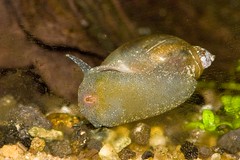
These little fresh water gastropods are from my son's aquarium. I believe that the snail is a Lymnaea sp., but I'm not a freshwater gastropod expert . It is dextral (aperture is on right with the spire pointed and oriented to see the aperture), with a thin shell that has 5-6 whorls (see below). Adults (in our tanks at least) range from 10 to 25mm while the young, fresh hatches, are about 1-2mm. They are pulmonate with no operculum, lay eggs in a gelatinous mass on the under side of broad leaved aquatic plants. The feed mainly on algae and detritus, but will preferentially go after any rotting plant leaves. The tentacles are triangular with eyes at the base. As a pulmonate this snail regularly rises to the surface to refill it's pallial lung.

Lymnae snails are simultaneous hermaphrodites, and from 2 individuals a water body can quickly be colonized. Which is precisely what happened to our larger tank when some snails or eggs made it into our tank attached to some plants. Egg masses have 20-40 individual eggs each which hatch 10-14 days after being laid.

As an informal experiment we placed one single snail in our smallest tank when it was torn down and rebuilt. All previous snails were removed and the tank torn down to bare glass removing all substrate material. Sterile sand and gravel were used as the base, to which plants were added that were wiped down and inspected for snails and egg masses. Fresh water, shrimp and fish were added to the tank and it was allowed to settle for a month, during which time the tank was inspected daily for snails or snail egg masses. After a solid month with no evidence of any snails, an 18mm adult snail was moved from an adjacent tank. Again the tank was inspected daily for snail egg masses and a snail count made. After 45 days there was still only the one introduced snail in the tank. Now (3 months later) there are 50+ snails in the tank: one 18mm adult and 49+ young snails of 2-4 mm lengths.

Sperm sequestration? Self fertilization? Both are reported in Lymnaea so it is hard for me to tell exactly, but no matter which, it does reveal a key trait that these snails use to for survival and to exploit new territory.

CRW_2727

Lymnaea sp. Snail, originally
uploaded by:
EclecticEchoes


Kingdom
Animalia

Phylum
Mollusca

Class
Gastropoda

Order
Pulmonata

Family
Lymnaeidae

Genus
Lymnaeas