Insect Ecology Lecture
Just one of many lectures available at the new Pulse Project site. Looks like I can keep up with a weekly lecture series even when I am away from university!

Just one of many lectures available at the new Pulse Project site. Looks like I can keep up with a weekly lecture series even when I am away from university!
I love this video of Euglossine bees pollinating the brazilian orchid, Catasetum macrocarpum.
This may be the ultimate ecosystem service. The NC State University Insect Museum blog reports from a new study that calculated the worth of insects to agriculture:
"Looks like insects' total contributions to agriculture amount to €153,000,000,000 ($216,372,000,000), which is almost 10% of the value of all human food worldwide."O M G That is some serious figures! Go to the NC State Insect Museum blog to get the details and the link to the study. Bookmark it too, it is an excellent blog!
Its been a while since I posted an Invert job, lots of cool opportunities flooding my inbox! Check this one out.
-------------------------------------------------------------------------------------
We are seeking highly qualified applicants to pursue graduate degrees in ecology, starting in the Summer or Fall of 2009 in the lab of John Drake at the University of Georgia Odum School of Ecology (website: http://dragonfly.ecology.uga.edu/drakelab/index.html. Research in this lab focuses on population dynamics in experimental systems, infectious disease ecology, and ecology of invasive species. We have strengths in modeling, computation, and stochastic population theory. Recent projects include invasive aquatic species in the Great Lakes of North America, extinction in experimental zooplankton populations, and modeling disease outbreaks. For other past research see http://dragonfly.ecology.uga.edu/drakelab/research.html. Students interested in either modeling/computation/theory or empirical research are encouraged to apply. Potential students are strongly encouraged to email (jdrake[at]uga[dot]edu) a letter of introduction and expression of interest well in advance of the application deadline (approx. November 1, 2008).
POPULATION ECOLOGY OF BRANCHIOPODA IN TEMPORARY PONDS
Drs. John Drake (University of Georgia) and Stephen Golladay (Joseph W. Jones Ecological Research Center) are seeking a graduate student at either the MS or PhD level to study the population ecology of rare branchiopod crustaceans in temporary ponds of the Ichauway conservation site in southwest Georgia. Results of this work will be used in the conservation and restoration of coastal plain isolated wetlands. The successful applicant will complete coursework at the Odum School of Ecology (University of Georgia) and will be subsequently stationed at the Jones Center for research. For more information about the UGA graduate program in ecology, please see http://www.ecology.uga.edu/programs.htm. For more information about joint program between the Odum School of Ecology and the Jones Center, please see http://www.ecology.uga.edu/facilities/assocfacil/josephjones.htm. For more information about the Jones Center, including information about the site, facilities, and programs, please see http://www.jonesctr.org/.
For more information about the Graduate Program in Ecology and instructions for applying, please see http://www.ecology.uga.edu/programs.htm. Funding is immediately available for the this position. Outstanding applicants with other interests are encouraged inquire for information about fellowships and other sources of funding.
NOTE: DR. DRAKE WILL BE AT THE ECOLOGICAL SOCIETY OF AMERICA MEETING IN MILWAUKEE FROM SUNDAY 8/3 TO FRIDAY 8/8.
Madhusudan Katti has the latest and perhaps greatest Oekologie blog carnival ever. Its HUGE and with such a great and diverse selection. Well done Madhu! Go over and check it out now and poke around his very interesting blog called Reconciliation Ecology. He has a lot intriguing posts on how humans interact with their environment.
Editors note: Since Eric started this whole bee thing. I am posting this press release I wrote as part of a writing exercise for a job application for the NAS.
Extensive bee decline has the agricultural community in a panic. Bees are responsible for pollinating many crops and provide a service to the industry estimated at $15 billion a year. Diane Cox-Foster, professor in the Entomology Department, Penn State, and colleagues report in the journal Science a correlation between this decline, called colony collapse disorder (CCD), and Israeli Acute Paralysis Virus (IAPV).
CCD is diagnosed by an inexplicable disappearance of adults, leaving honey, pollen and grubs behind. Surveys detailed a loss of 50-90% of commercial bee colonies. The first reported declines were in 2004, corresponding to when the U.S. allowed imported bees from Australia. This study is the first report of IADV in the United States.
The study’s authors report that IAPV was only found in CCD hives and from Australian samples, but caution this may be part of a multifaceted attack including parasites, poor nutrition, pesticides and environmental stressors. Future research will study the role of IAPV in CCD in relation to these stressors.
The National Research Council report Status of Pollinators in North America concluded that populations of North American pollinators are in rapid decline. More than three-quarters of commercially important flowering plants need pollinators for fertilization. The honeybee is responsible for pollinating over 90 crops. Causes for the decline are difficult to determine due to inadequate data. The report recommended establishing a network with Canada and Mexico to form long-term monitoring projects, along with a comprehensive survey to gather baseline data for future population assessments.
• NRC Report Status of Pollinators in North America
Other Resources:
• NAS press release: Some Pollinator Populations Declining; Improved Monitoring and More Biological Knowledge Needed to Better Assess Their Status
• Cox-Foster et al. (2007) A Metagenomic Survey of Microbes in Honey Bee Colony Collapse Disorder. Science 318 (5848): 283-287. Doi: 10.1126/science.1146498
• AAAS teleconference with study’s coauthors (teleconference begins around three minute mark)
 While the deep-sea may be the final frontier for marine biologists, caves are one of the least studied environments on land. Some caves can extend dozens of miles below the ground in sinuous networks, all but cut off from the grassy hills and tree-lined horizons above. Its not an easy environment to access and many explorers have perished attempting to map these subterranean labyrinths. Yet, recent investigations have found an astonishing community of invertebrates associated with caves, existing nowhere else. Many of these species are insects and spiders, adapted to the dark conditions, muggy conditions. Nearly every new cave expedition turns up species never before seen.
 How do these animals exist down there? What is their source of food? It turns out that nestled in the Blue Mountains of Australia at the 350 million year old Jenolan Caves Karst Conservation Reserve, the base of the invertebrate community consists of decaying leaf litter. Eucalyptus trees, native to the area, historically contributed the most to the leaf litter pool. Over the years, introduced trees have naturalized around the cave opening. Sycamore from Europe was brought in to stabilize steep, rocky slopes and Radiata Pine from North America was provided for the timber industry. Hills and colleagues from the University of Technology Sydney compared leaf litter decomposition rates and invertebrate diversity between the 3 leaf litter pools in "twilight" areas (i.e. near cave openings) and "dark" areas deeper in the cave.
The introduced Sycamore leaves decomposed much faster than the radiata pine needles and native eucalyptus leaves. This suggests that Sycamore leaves release more carbon and nutrients into the cave ecosystem, potentially supporting a more abundant and diverse invertebrate community. Interestingly, there was no difference in leaf mass loss between twilight and dark leaf litter. Proximity to above-ground features like light, rain and wind appear not to affect leaf litter decomposition.
Before I discuss the trends for invertebrates there, I want you to sit back in your chair, take a deep breathe and relax. Close your eyes and envision a cave. Its dark, moist, there is only one opening. All that remains of it is a singularity of daylight. For hundreds or thousands of years this cave has been fed organic matter from the surrounding vegetation. Trees such as Eucalyptus abound in the limestone hills, shedding off their leaves which make their way by the cave opening eventually being blown in by a gust of wind. This occurs daily for millennia. Insects and arachnids feast on the leaves as well as the fungi and bacteria associated with the leaf matter. Over time one might suspect that the animals become adapted to the leaf litter type in some way.
Fast forward to the last 100 years and globalism has introduced new organisms to every corner of the planet at an unprecedented pace, including Sycamore and Radiata Pine to eastern Australia. Are the invertebrate communities more diverse and abundant on the native vegetation that is may have adapted to? As you can see from the above figures, abundance and species richness are much greater for the introduced european Sycamore than either the pine or Eucalyptus, especially nearer the cave opening. The authors don't really nail the answer with their experiment, but narrow it down to attributes of Sycamore that favor colonization by invertebrates over Pine and Eucalyptus. For instance, Sycamore has a higher specific leaf area (SLA) than both Pine and Eucalyptus. A low SLA is associated with long-lived leaves containing many structural and defensive compounds. These trees invest heavily to guard against plant-eaters whereas the broad-leafed Sycamore does not invest against herbivory, so leaves break down quickly. This faster nutrient release may be part of the reason sycamore leaves have a more abundant and diverse community.
So what would happen if Sycamore were to completely supplant Eucalyptus? It is a higher nutrient leaf and releases carbon faster (i.e. breaks down faster), so it should be better for the spineless society down under, right? One problem is that Sycamore is a deciduous tree. This means nutrient pulses to the caves would occur on a seasonal basis. Since its leaves break down so quickly, this pulse would be short lived compared to the structurally-strengthened Pine and Eucalyptus, both of which keeps their leaves year-round. Being below-ground, caves are protected from the variability of the seasons and are relatively stable environments in terms of climate. The invertebrate community there needs a more constant or stable supply of leaf litter to be sustained. The authors propose
"The short-term influx of energy provided by sycamore litter could be detrimental to subterranean invertebrate diversity in the long term. We would expect to see invertebrate species predisposed to utilizing sycamore derived energy dominating subterranean invertebrate communities and perhaps out-competing other invertebrate species, thereby reducing invertebrate diversity."Interesting food for thought: nutrient pulses reduce diversity over time. On the other hand, if the authors are talking about partial species replacement, I would also expect to see increase in diversity pooled over the whole year. If this is only a seasonal phenomenon, complete species replacement would be unlikely given that established invertebrates that can utilize multiple plant sources over the year will persist over the long-term. It would certainly be an idea worth funding, especially from the angle that caves may be sheltered from the immediate effects of climate change. A nice replicated mesocosm study within the caves and near the entrances. 'X' amount of replicates sampled throughout the year at various time points to gauge the effect of seasonal nutrient pulses. How about adding various mixtures of different quality leaves to test the hypothesis that maximum food quality results in highest species richness.
Rick MacPherson is in Turks & Caicos for a meeting and is urging us to Honk if we like Conch.
Oh, man, do I love conch!
When I lived in Honduras, I was fortunate enough to get out to Roatan every few weeks for diving, Garifuna music, good food, and relaxation. One of the best parts for me was the near daily serving of conch. Usually it was as conch salad, but I love them in fritters as well. Unfortunately, Honduras Queen Conch are still being heavily fished, even though their numbers have decline very sharply since tourism increased.
And Belize... During my recent trip to Belize at South Water Cay and Carrie Bow Cay, there were only a handful of live conch to be seen, but hundreds of empty shells. Most of the live individuals were 2-3 years old. This is very disconcerting for a species which doesn't reach full size until 4-5 years and can live for up to 40 years. The large number of empty shells were often occupied by damselfish (Stegastes spp., especially beaugregories, who use them as shelter and nesting grounds, the little buggers can be quite aggressive about it as well (a study of that aggression was one of the things we studied there.)
Steve Palumbi has a nice Micro-Documentary movie about the
lifecycle of Conch at the Garthwait & Griffin Films MicroDoc website. Just found out that all the microdocs are now available on DVD through them. (They are also at Palumbi Lab at Stanford.)
If you love reefs, seagrass beds, and invertebrates, how can you not love the conch, a giant marine mollusk that helps keep macro algae under control? And they taste good. Oh, wait...except the whole CITES II listing and dangerously decreasing population, conservation...
Well, it looks like there are a few successful, complete life cycle conch ranching operations and Rick reports on the one in Turks & Caicos, Caicos Conch Farm, which appears to be doing a great job of helping wild conch populations, while continuing to provide a sustainable source of conch meat and shells.
Freshly returned from a trip to Washington D.C. with my family (in case you were wondering why blogging has been nonexistent), here is the 15th edition of the blog carnival on ecology and the environment!

 In other ecological news, Matt Mendenhall describes the palaeoecology of the forgotten, flightless seaduck of California (see image on left, source: Wikimedia commons). Ed Yong translates some new research on the trophic effects of introduced rats on islands. Controlling invasives is never an easy task, there are many confounding factors. John Beetham reports on the potential for the univoltine root mining weevils to control the invasive pervasive garlic mustard. Lets hope the biocontrol agent does not itself become a pest to other native plants.Finally, its the Year of the Frog! Jennifer tells us about FrogWatch. Spring is coming upon us in the north and I am anxious to take my son out and go frog hunting!
Tidepooling was an activity that made me as giddy as a kid in candy shoppe. There is little as pleasurable as exploring the minute natural saltwater aquaria and finding new creatures in each little pool. Being locked in coastline-less PA, I have not visited a tidepool in ages except when on vacation, where my last several coastal destinations have not been rocky :(
Dorid, over at the Radula, recently let me relive my tidepool giddiness by posting a primer on proper tidepooling. I'm very proud of her proper use of brittle star and sea star, as well her identification of "snail tubes" I'm not sure many non-invertebrate biologists would get that. Maybe polychaete tubes, but these tubes actually belong to a relative of the snails called Aplacophorans.

Just got wind of a conference that sounds pretty awesome: Bioturbation: an update on Darwin's last idea. This is of course in reference to one Darwin's last great works: The formation of vegetable mould through the action of worms, with observations on their habits. The conference objectives are:
(1) To bring together scientists from different disciplines to provide an update on bioturbation from different perspectives, such as ecology, geochemistry, marine biology, paleontology, etc.
(2) To stimulate the exchange of ideas across the marine/terrestrial and paleo/present boundaries. We strongly invite “crossing-boundary” presentations.
(3) To present the state-of-the-art in theoretical concepts, mathematical models, experimental data acquisition techniques, and existing datasets.
We stimulate "off the record" presentation of previously unpublished scientific results, and we will allocate ample time for formal and informal discussion among the attendees.
Organizing committee: Bob Aller (SOMAS, SUNY Stony Brook), Erik Kristensen (Institute of Biology, Univ. Southern Denmark, Odense), Franck Gilbert (EcoLab, Univ. Toulouse), Jack Middelburg (Dept. Ecosystem Studies , NIOO-KNAW, Yerseke), Filip Meysman (Lab. Analytical and Environmental Chemistry, Free University of Brussels).
2008 is the year to LIVBLUE: "Live like you love the ocean." That is why are ocean bloggers. The ocean holds a special place in all of our souls. A place where life came about, evolved and was cradled. A historical refuge from extinction. A place where bountiful resources nurtured early civilizations. A superhighway and living market for modern civilizations. Yet a place where we can rest our weary bodies, contemplate and find inspiration.
But the ocean is heaving and sighing with the weight we have put on its back. Its bounty is growing scarcer, its resources diminishing. Once a refuge, now plastic and debris, oil spills, toxic chemicals and metals, munitions dumping, and other ailments have made the watery milieu an obstacle course for its inhabitants and there are no do-overs in this game. This may not be news to most of us. As ocean bloggers, we become accustomed to catastrophe, often the harbinger of bad news.
There is another route we can take. We can become messengers for sustainability, accountability and reformation. Humans have a close connection to the water. We are evolved from it. We are born into it. We bath in it, letting it embrace us as we cleanse ourselves. We drink it and made up of it. Not all humans will share in the full enthusiasm and passion of an ocean blogger, but they are interested in the ocean, even if never having been there. They eat from its cornucopia. They buy products that were shipped across the seas on ocean liners. They feel a pain and sense of loss when shown oil-covered seagulls and otters, or sea turtles and sharks wrapped up in thin fishing wire. I have faith in people that they generally want to do whats right.
I am calling upon all ocean bloggers to use the power of the proverbial pen in 2008 to dedicate their writing not to solving these issues. Politicians and policy-makers do read us. Everyday people read us. Our pen is better suited to educating people on not what the problems, but why they exist, who is responsible, what can be done at a local level and how to sustain a lasting commitment to the health and sustainability of our oceans and its resources.
A few weeks ago I organized and gave a session on Real Time Blogging in the Marine Sciences at the North Carolina Science Blogging Conference with my ocean blogging colleagues Peter Etnoyer from Deep Sea News, Jason Robertshaw from Cephalopodcast, Rick MacPherson from Malaria, Bedbugs, Sea Lice and Sunsets and Karen James from The Beagle Project. It was a learnign experience for myself and I think its safe to say for everyone involved, be it the co-moderators and the audience.
Real time blogging to me is the art of bringing the excitement of discovery and the process of being a discoverer to the front door of the average citizen. It captures the immediacy of the moment in all of its unedited glory. There was a lot discussion generated, which would have gone on if it weren't for the 70 minute time limit. Rick has a great analysis of our session, so I won't belabor the point here. Jason video-taped the session and has it archived here for your viewing pleasure. Additional coverage includes photos from myself (here and here too), swag from Rick, commentary and analysis from Peter and Karen as well. I came away from the whole conference with a renewed interest in blogging as a tool for public discourse and now feel more determined than ever to blog, one of several reasons I have joined the crew at Deep Sea News.
But this Carnival of the Blue is not about me, its about ocean blogging. I feel, in the water, that 2008 is going to be a big year for the Blue. It is the International Year of the Reef. Conversation has already been going on reef conservation in anticipation of this event. In 2008, I expect ocean blogging to increase, more bloggers, more discussion, more solutions. Last month, Mr. Byrnes gave us an excellent entry into this year with Carnival of the Blue #8. The Carnival of the Blue, started by Mark Powell at Blogfish, is showing steady growth. I hope it continues and that there will be more submissions from new ocean blogs and other blogs that are talking about ocean related issues. This month we have a mix of both.
Before you continue reading, head over to Cephalopodcast and start playing the latest internet radio program offered by Jason Robertshaw. Among the many pearls of marine news Jason finds, this episode also features an interview Mark Powell where they discuss the Carnival of the Blue and ocean blogging. His soothing radio voice will make a wonderful narrative while you peruse this carnivals offering.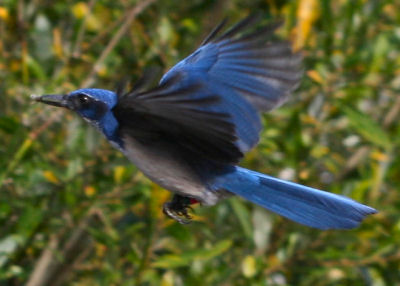 Corey at 10,000 Birds tells us of his discoveries of the maritime avifauna on the Santa Cruz island, part of the California's Channel Islands. In particular the Island Scrub Jay, a close relative of my favorite bird from my Monterey days, the Western Scrub Jay. Special bonus: a pod of dolphins on the boatride!
A common theme ocean is that of "shifting baselines". A term coined by marine biologist Jeremy Jackson to refer to the idea that each generation has different view of what the baseline is because they only remember what the world was like when they were growing up. Jennifer Jacquet at the Shifting Baselines blog illustrates this point well with a discussion of baselines shifting as evidenced through ship captain's logbooks. Sheril Kirshenbaum at The Insection tells us that the next hot fishery is Hagfish. Which makes me wonder, will fish sticks soon be fried hagfish slimeballs? As Jennifer would say, "... just another shifting baseline..."
Public perception is important to individuals and corporations. Some ways of perceived can be clever while other irritating at best. Rick at Malaria, Bedbugs, Sea Lice and Sunsets explains the history behind the mermaid in the Starbucks logo and discusses what is the marine world equivalent of the cute and cuddly mascot, Woodsy Owl. Additionally, Miriam at The Oysters Garter wonders why Oceana is trying to spread its conservation message by spam.
 Emmett Duffy at The Natural Patriot offers us beautifully narrated journal entry from his latest research excursion to Jamaica where he was "filled with a powerful sense of calm and gratitude and harmony". So touched was he by his jamaican experience he named this new species of social shrimp Synalpheus irie, irie being rastafarian for "high emotions and peaceful vibrations".
"This 286-page work contains 6,793 valid species and subspecies, 1,271 genera and subgenera, 93 families and 38 superfamilies, making it the most comprehensive to date. And with references as recent as January 2008, it is also the most up-to-date."That is it for this edition of the Carnival of the Blue, Kate Wing will be hosting #10 in March. Remember to live like you love the ocean.
Post-doctoral Scientist in Agroecology
Penn State University
Depts. of Crop and Soil Sciences and Entomology
Interdisciplinary study on weed population management and dynamics, arthropod community, soil quality indicators, nutrient cycling and agronomic properties in organic cropping systems. The successful candidate will serve as project manager, analyze weed, arthropod, soil C and N, agronomic, environmental and economic data; collaborate with other investigators on project to publish findings, and participate in extension and grant-writing activities. PhD in weed-, arthropod-, soil- or agro-ecology required. Experience working with complex systems studies is desired but not required. The post-doctoral scientist will work directly in collaboration with David Mortensen (weed ecology), Mary Barbercheck (arthropod ecology), and Jason Kaye (biogeochemistry), graduate and undergraduate students, technicians, and a farmer advisory panel in guiding the research and outreach education associated with the project. Please send CV and list of 3 references to Mary Barbercheck, meb34[at]psu[dot]edu, by February 29, 2008. For further information, contact Dave Mortensen, Penn State Dept. of Crop and Soil Sciences, dmortensen[at]psu[dot]edu
Note the closing date for applications is March 30th 2008.
Summer Research in Dublin
Collections-Based Biology in Dublin (CoBiD)
Undergraduate Research Experience & Knowledge Award
This summer programme offers research projects and activities for
students in organismal biology using biological collections
Research Projects
extreme environments | fire ecology | DNA barcoding | freshwater
ecology | biocontrol | environmental epigenomics | terrestrial ecology
| invasive species | plant evolution and extinction | life history |
genomic imprinting
Requirements
completion of the third (junior) year of an undergraduate biosciences
degree | ability to work independently | strong interest in the
project of choice | career goals in organismal biology
Full funding for the 10-week programme will be provided for 10
successful candidates, including assistance with air transportation to
and from Dublin, accommodation in Dublin, and a small weekly
allowance, as well as project expenses. Prior experience with museum
collections is not required – one of the goals of the programme is to
expose students to new research skills. The programme is open to all
international as well as Irish and EU students.
Term dates: June 16th to August 22nd 2008
For application instructions and more information:
http://www.ucd.ie/ureka/
Applications must be received by 30 March 2008
*Via the Mollusca listserve
 Image from my favorite vermicomposting site for children: Worms.com. A must see especially for parents and teachers!
 Richard Black, environment correspondent for the BBC, has a nice news article on small invertebrate larvae (such as the annelid juveniles in the photo) that live within the small briny channels inside the arctic ice. Required reading for the week is Rich Life Emerges from Nature's Freezer.
GRADUATE FELLOWSHIP IN BLUE CRAB ECOLOGY AND CONSERVATION
School of Marine Science, Virginia Institute of Marine Science,
The College of William and Mary, Gloucester Point, Virginia
The Willard A. Van Engel (WAVE) Fellowship was established to promote research in blue crab ecology and conservation. Individuals of outstanding ability are selected to conduct research leading to a Ph.D. or M.S. degree in the School of Marine Science of The College of William and Mary. The 3-year fellowship is available beginning Summer or Fall 2008 in support of graduate research on the blue crab in Chesapeake Bay, with emphasis on any of the following: environmental and biotic control of recruitment and population dynamics; marine protected areas; predator-prey interactions; and ecosystem-based management.
Questions regarding potential research projects should be directed to: Dr. Rom Lipcius (rom::at::vims::dot::edu, http://www.vims.edu/fish/faculty/lipcius_rn.html).
The fellowship offers an annual stipend of approximately $18,000 plus full tuition, and research and travel funds for 3 years, dependent on satisfactory progress. A 4th year of funding is possible given significant progress towards completion of the degree. The fellowship may be initiated in Summer 2008 to allow the conduct of research prior to classes. Candidates must be US citizens and accepted to the School of Marine Science.
TO APPLY:
1. Submit an application to the School of Marine Science. Deadline for receipt of applications to the School of Marine Science is 15 January 2008. Application information for the SMS is available at http://www.vims.edu/sms/. Application materials may also be obtained from: Dean of Graduate Studies, Virginia Institute of Marine Science, The College of William and Mary, P. O. Box 1346, Gloucester Point, VA 23062; and,
2. Send a letter requesting consideration for the WAVE Fellowship and a resume by 15 January 2008 to: Roger L. Mann, President, WILLARD A. VAN ENGEL FELLOWSHIP, Virginia Institute of Marine Science, The College of William and Mary, P. O. Box 1346, Gloucester Point, VA 23062.
 Castilla et al. (2007) are reporting in a recent PNAS article an interesting property of sea squirt pornography and local oceanography. I know, I'm a frequent purveyor of tunicate smut, but this utter filth may have consequences in the debates surrounding marine reserve design. These authors studied the spawning behavior of intertidal tunicates (Pyura praeputialis, an invasive) from chilean coasts. What they found will make all decent folk turn their insides out. These filthy denizens of the seas let it all out together in a mass orgy. Oh the indecency. Are you sure the children are asleep and not watching over your shoulder? You may want to tuck them in before continuing on.
Sea squirts have mobile "tadpole"-like larvae whose role is typically dispersal since they do not feed. The also don't stay in the water column for too long, preferring to stick their heads to a rock somewhere (figure below shows larval metamorphosis).
 A) Mass splooging of P. praeputialis. B) Sperm (SS) and egg (ES) suspensions left dripping in the intertidal. C) 2 meters of foamy splooge. D) Chilean researcher knee-high in sea "squirt" if you know what I mean... Fig. 1 from Castilla et al. (2007).
Not only can your prey give your nourishment and a full belly, it can also be a shield to protect you from predators! A recent article by Jackson & Pollard in the Journal of Zoology described an interesting study in which the ant-snatching assassin bug (Acanthaspis petax) makes a "backpack" of its dead prey to avoid being seen by its predator, the deadly jumping spider (Salticidae)! Masking to avoid predation is not a novel development. There are decorator crabs who will take just about anything and put it on its back (including other live critters), sea urchins will don mussel shells and some weevils will even grow fungi, algae or moss on its back. What I think is cool about this system is the use of "corpse camouflaging". Not only can it save you from starvation, it can save your butt too!
"...they capture prey by grabbing it with their legs, piercing it with their syringelike mouthparts and using the ‘syringe’ to inject digestive enzymes and paralysing saliva. The bug then proceeds to suck up the digested ant tissues from inside the ant’s exoskeleton. Once finished, the assassin bug places what remains of the ant, an empty shell, on its back. The ant carcass adheres because of fine adhesive threads that the bug secretes from its abdomen."-Jackson & Pollard (2007)Now thats recycling! I think we can learn something here. Perhaps we should recycle our food waste into new and life-saving innovations. Hmm... what can we do with all those leftover lemon and orange rinds?
 Figure 1 (from Jackson & Pollard (2007)): Two juvenile Acanthaspis petax: one without (left) and one with (right) a mask constructed of ant carcasses.
"... that the salticid readily detects the masked bug as an object separate from the background, but it fails to identify it as potential prey.[...] As most salticids may be averse to preying on or coming close to ants (Nelson & Jackson, 2006), the fact that the bug’s mask is normally made of ants may be important when the bugs encounter salticids."-Jackson & Pollard (2007)It would be interesting to see how this behavior evolved, what genes turn on this behavior. Once the gene(s) is/are found, how does that gene's phylogeny map over more conservative (i.e. less selected) genetic markers like mitochondrial DNA? A cross comparison with other decorating species would be very interesting in understanding the evolutionary history that gave rise to decorating behavior and how that behavior became instinct that is rooted in the taxon.