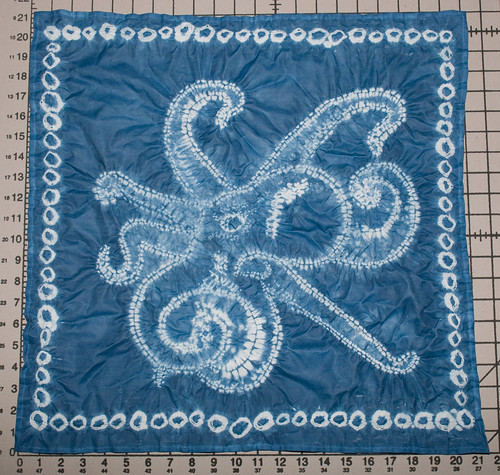
Octopus Ballet
2005 off the Oregon Coast, the Octopus Ballet debuted as part of the Visions'05 expedition, featuring the ever graceful Grimpoteuthis bathynectes
TweetTip from Kaylin-Quinn

2005 off the Oregon Coast, the Octopus Ballet debuted as part of the Visions'05 expedition, featuring the ever graceful Grimpoteuthis bathynectes
TweetTip from Kaylin-Quinn
Night diving, squid and reproduction...
what a combination! Be sure to read Miriam's writeup for all the details.
These two dives were 21 days apart, one from early March the other late March, notice any differences?
From the Night of March 7th:
Squid Spawning Grounds Off La Jolla from Gary Hawkins on Vimeo.
From the night of March 28th:
Squidilicious from Gary Hawkins on Vimeo.
If you've followed this space at all, you probably are aware of my fascination with cephalopod camouflage and behavior, so it should come as no surprise that this weeks video would be the Indonesian Mimic Octopus, Thaumoctopus mimicus.

It's an octopus, it's a box, it's an Octo-box!
Jeff Ives, the New England Aquarium's resident Firend of the Invertebrates, brings us a wonderful sequence of their Giant Pacific Octopus (Enteroctopus dofleini) having a little dinner. Check out the entire sequence of photos posted at the New England Aquarium's Giant Ocean Tank Blog.
A great demonstration of the intelligence and determination of the cephalopods.
This one made the twitter rounds with tweets from Jason and KaylinQ. Excellent hunting behavior captured as it hunts shrimp inside sponges and the surrounding algae. Of course I'm mesmerized by the color and texture changes as it goes from hunting to capture to post capture. The concentric orange and white circles in the "white square" position of Roger Hanlon's experiments and the orange posterior triangle. The complex patterns that emerge at the moment of capture an immediately after are very cool as well. Amazing animals, these king of the molluscs.
I received the sad news today that Martin Wells, imminent biologist, one of the founders of Churchill College at the University of Cambridgeand, a great friend of the cephalopods and all marine invertebrates, has passed away at the age of 80. Son of H.G. Wells, Martin was a highly accomplished biologist who was especially inspired by cephalopods and other marine invertebrates. His wonderful book Civilization and the Limpet
Tentacular "high fives" are in order for Miriam Goldstein of the Oyster's Garter! Besides being one of our favorite invert bloggers and shanty singers, she is now a Slate author.
On Friday Slate posted a brilliant article by Miriam in their XX Factor section detailing The six secrets of squid sex - advice to a young Loligo opalescens on how to successfully complete the mating imperative and pass on it's genes to the next generation without being caught by the ultimate hectocotylized fourth blockers, human fishermen. In wonderful prose she describes all the beauty of squid orgies, but just to make sure there is no confusion (and to satisfy our voyeuristic desires) she includes an awesome video segment, from one of my favorite underwater filmakers and videographers – Howard Hall Productions, of male consort mating and a sneak attack attempt by a smaller male - simply beautiful!!
And just to keep the science cred's super high, she has a companion post up at the Garter with all the research citations, lab links and name drops of squidly delight!
Purely for your voyeuristic entertainment, here is another nice video from some scuba divers of the massive squid orgy off La Jolla from last year. Thousands of squid in flagrante delicto.
 Roger Hanlon, from the Woods Hole Marine Biological Laboratory, came out to UCONN's Avery Point campus to present for our Friday seminar series. His presentation was a good overview of his lab's work on cephalopod camouflage behavior over the past decades, with the majority of the discussion on the work they have done recently with the cuttlefish Sepia officinalis. So I hope you will bear with me while I gush on a bit about my favorite group of animals and their amazing adaptations, which allow them to confound predator, prey, and researchers alike!
One of the first videos (of many) presented was one which leaked to YouTube in low res, but, of course, Roger had it in full resolution and projected large. The video is a magnificent example of high-fidelity camouflage by the octopus employing all its tricks. I've seen an octopus disappear in front of my eyes only once and it was simply amazing. I've seen Roger's video three or four times in high resolution, and each time I get the same wonder-filled reaction. I've probably seen it a hundred times in YouTube's low resolution and even there it makes me pause. For some reason the majority of people who view this think the tricks in the video are in post production not from the octopus...go figure.

Where's the octopus?
Image copyright Roger Hanlon

From Sutherland et al. (2008).

Two frames about 10 seconds apart from video by Roger Hanlon. In the first image the male is on the left of the female, showing her a calm, courting display. The stark white display facing away from the female is an aggressive display, warning other males to keep away. In the second frame the male has switched to the right side of the female when she moved and changed his color patterns to keep the docile pattern visible to the female and the aggressive warning showing outward to any other males. Total color change occurred in ~2 seconds.
Images from video, copyright Roger Hanlon

Disruptive skin components of cuttlefish Sepia officinalis, including the "white Square Component" indicated by the number 2 at the joint of the "T" formation in the left figure. On the right is the result of comparing various sized cuttlefish with various sized grid patterns. At all sizes when the area of one square of the grid is between 40 and 120% of the area of the cuttlefishes white square component, it will utilize the disruptive camouflage. Below and above those relative sizes and the animal moves to mottled or uniform patterning.
From Barbosa et al. (2007).

What happens when the vertical and horizontal patterns are radically different? Qualitatively, the cuttlefish appear to weigh the vertical visual cues over the bottom cues slightly. Quantitatively this is born out in only three areas of the cuttlefish's body.
Figures from Barbosa et al. (2008)

Evaluating background pattern contrast as well as check size as cue for uniform, mottled or disruptive camouflage pattern employment by S. officinalis
From Barbosa et al. (2008)(b)
. Since we lingered so long, my family decided to get Thai for dinner from a new restaurant near the school. First two items up on the specials for the night? Ok, finally got all that writing stuff done so I can connect to the net again. Jack in and what do I find?
Almost every way of preserving it makes it shrink!
The Te Papa staff are counting down the days to their new exhibit of the colossal squid:
Of course in the original press surrounding the capture of the squid, it was mentioned by many sources that the squid was thought to have a total length in excess of 6 metes and possibly as long as 8m. When it was dissected and preserved, it measured out at 4.2 meters. The museum researchers and staff decided to see if there was a cause for the discrepancy and found that the original, unpreserved flaccid length was probably about 6 meters. Of course since squid have no bones and extremely elastic tissues, when it was alive and under the proper stimulation the squid may have exceeded 8m in length.
I only wish there was a way for me to get down to NZ over the break. Hmmm... wait there is a symposium on deep sea coral in NZ next week... maybe Professor A. would take me with him...I can ride in the suitcase for deep sea coral associate ecology and Te Papa... Passport's ready and up to date...besides, I wanted to check out grad school opportunities down there. Hmmm....
 CEPHALOPODS HAVE TAKEN CONTROL of this month's Carnival of the Blue!!! There is much fine tentacled offerings over at the Cephalopodcast. Jason lays it out real nicely and offers entertaining commentary. Lots of great links so be sure to drop by for a visit and check the place out! Deep Sea News will be hosting the next edition of the Carnival of the Blue in November, so be sure to write some great posts on anything related to the oceans and let them know!
It actually was linked to from one of the stories on Steve O'Shea... so...
and in related news...
Next Sunday (August 31st) looks to be an Ocean and Invert bonanza on the Discovery Channel.
It starts off at 3pm with all 4 hours of the Blue Planet
At 7pm we start up three marine invert hours of fun with the Killer Jellyfish! The story about the search for the Irukandji
Mesonychoteuthis hamiltoni, the Colossal squid, is usually thought to be a pretty aggressive deep sea squid, but based on his research of the recently dissected speciment Steve O'Shea has this to say:
"We are looking at something verging on the incredibly bizarre. As she got older she got shorter and broader and was reduced to a giant gelatinous blob, carrying many thousands of eggs,"Of course this is an early hypothesis based on the examination of one specimen...
"Her shape was likely to have affected her behavior and ability to hunt. I can't imagine her jetting herself around in the water at any great speed, and she was too gelatinous to have been a fighting machine."
“It’s not sitting down there sipping on cups of tea or anything like that."You just gotta love cephalopods!
Working to finish up a deep sea PSA that will hopefully one day be seen by the wider public, so not much time for invert love, but there have been some good online distractions today... If you haven't been to the Catalogue of Organisms yet today, you might not know that you too can Get Kunstformen! and have Haeckel on you hard drive, an absolute must for any bio-bibliophile (thanks Christopher!). It's hosted at BioLib where they have scanned some 474 biology books gook back to 1545, most from 1800's and early 1900's. Personal favorites include p.237 and 247 (among others) Yours?
Meanwhile in squid news, yesterday Peter brought us some jerky but beautiful video from an oil platform in the Gulf of Mexico. A Magnapinna spp. squid hangin out 7800' (2.3km) down. Yeah, turns out oil platforms can be a great source of science exploration too. When they send their ROV's down, they are working all the way down, inspecting the platform and the well head etc. Often though, they have no mission on the return trip and they have to do periodic missions just for training and proficiency. These non-oil-rig oriented mission hours can be used with the vehicle turned outward to watch for squid, whales and greenland sharks.
Of course that doesn't mean I support irresponsible expansion of our offshore drilling program. Miriam takes on the propaganda coming from certain quarters to play on the public gas-price pains and fears with a push for increased offshore oil-drilling. After tearing up the main points of McBush Sen. McCain and the GOP's arguments, Miriam adds a compelling new twist - she doesn't want us to give jellies the keys to the liquor cabinet.
I'm in the process of narrowing down my options for masters programs for next fall and ran across the Marine Biology program at the University of Groningen and its opportunities for masters research page. A number of interesting projects there, but one that caught my eye especially was the Jetpropulsion in juvenile squids and cuttlefish with Eize Stamhuis & Henk-Jan Hoving. Combines molluscs (even better cephalopods), juvenile forms, physics and scuba for sample collecting!
"Juvenile squid and cuttlefish start to swim immediately after hatching from the eggs. Adult squids and cuttlefish propel themselves by jet-propulsion, that is by accelerating a mass of water through the siphon outwards by contraction of their mantle. This process relies on inertial forces only: action = reaction ( Newton ’s third law). Freshly hatched juvenile squids and cuttlefish are so small (2 to 5 mm) that viscosity may also be a ruling factor. Till today, nobody has studied the flow producing capacities of juvenile cephalopods in relation to adults. Here we plan to have hatching squid and cuttlefish eggs in the lab to study the swimming behaviour of the juveniles as well as their flow production capacities immediately after hatching to study how they deal with the balance between viscosity and inertia."
When directed to the Pink Tentacle for some potentially cool reef spying equipment by Deep Sea News, I, of course, was drawn to the entry further down about a 96 armed octopus. All the offspring were normal...but... here's another look at the 96 armed momma:
Check out the Pink Tentacle for more mutant Japanese octopi, or if you read Japanese...the Shima Marineland Aquarium has a few log entries on cephs.
I did a quick search at TONMO and found that though seemingly very rare, this branching is not entirely unreported in the literature.
Unfortunately all the articles are unavailable through my institution! If anyone has access to any of these...
Okada, Y.K. 1935. An octopus with branched arms and mode of branching. Annot. Zool. Japon. 15: 5-23.
Okada, Y.K. 1937. An occurence of branched arms in the decapod cephalopod, Sepia esculenta Hoyle. Annot. Zool. Japon. 17(1): 93-94.
Okada, Y.K. 1965a. On Japanese octopuses with branched arms, with special reference to their captures from 1884 to 1964. Proc. Jap. Acad. 41(7): 618-623.
Okada, Y.K. 1965b. Rule of arm-branching in Japanese octopuses with branched arms. Proc. Jap. Acad. 41(7): 624-629.
Smith, E.A. 1907. Notes on an "Octopus" with branching arms. Ann. Mag. Natur. Hist. 7: 407-411.
Keeping with the B-grade horror flicks starring inverts...
On a gently rocking vessel in the warm waters of the Sea of Cortez, a young oceanographer earnestly watches her computer screen while colleagues lower a cable into the water. Instruments aboard the ship, the Pacific Storm, ping sound waves toward the cable. The oceanographer’s eyes flicker across the screen to make sure the signal is clear. Tethered to the cable is a 5-pound Humboldt squid, and the sound waves, set at 38 kilohertz, bounce off the squid. An image shows up on the screen.
The oceanographer raises her fist in triumph. It marks the first time scientists had clearly picked up a strong sonar signal for squid, which lack the bones and swim bladders that give away other marine creatures.
Suddenly a second image appears, darting up from below. The acoustic signal tracks it from the depths toward the cable — and the tethered squid. It is another squid, larger than the first, and it attacks the tethered animal. The oceanographer screams.
Fade to black.
Since the Daisy Hill Cuttle Farm video of flamboyant cuttlefish mating is currently unavailable (Though Dorid saved the day with some good voyeuristic vids from her personal collection!) I thought I should endeavor to find some good cuttle porn. This cephalopod sex clip is from a longer piece available at YouTube. The rest of the piece is good, but it's mostly vertebrates teasing and eating each other. As a bonus the video has egg masses and cuttles hatching.
Zooilogix has some amazing moth pictures (and one butterfly) from Igor Siwanowicz. Simply Stunning.