Nature Blog Network
Showing posts with label Invert Life Photo. Show all posts

Thursday, September 3, 2009

Channeled Whelk with Egg Cases


Family friends bought us passes for Project Oceanology's Enviro Lab cruises at an auction this summer, and finally, as the summer draws to a close, we were able to take advantage of them. Project O is an outreach center that focuses on marine science and environmental awareness especially of the Long Island Sound ecosystem. Their Enviro Lab boats are equipped with a small sample trawl, water quality samplers and sediment samplers. I had been on the Enviro Lab boats with classes from the Marine Science undergraduate program at Avery Point (Project O is located on the Avery Point Campus).

For Johann and Tammy it was a new and exciting adventure. Johann's favorite part was examining the results of the benthic sample trawl. After seeing the Mystic Whaler (Which chanteyman extraordinaire Geoff Kaufman often sails aboard) he was inspired to sing a round of "Donkey Riding" as he reeled in the line from the trawl. The fun really started when he got to get really hands on with the samples helping quickly sort the haul and get all the animals into the large wet tanks. In the haul were a dozen Scup (Stenotomus chrysops), several Sea Robin (Prionotus carolinus), some Atlantic Moonfish juveniles (Selene setapinnis), what looked like a small striped bass (I didn't get to see it but that was the description), a feisty female little skate (Leucoraja erinacea) and a spotted hake (Urophycis regia).

While there was quite a number of vertebrates in the haul, there were far more inverts brought up. Among the inverts there were in excess of a hundred spider crabs (Libinia emarginata), two lobster (Homarus americanus,)(both female), two European Green Crabs (Carcinus maenas), one Jonah Crab (Cancer borealis), several broad-clawed hermit crabs (Pagurus pollicaris) and one male Horseshoe crab (Limulus polyphemus). Molluscs were well represented as well with many mud snails (Nassarius obsoletus) and slipper shells (Crepidula fornicata)as well as a half dozen loligo squid.

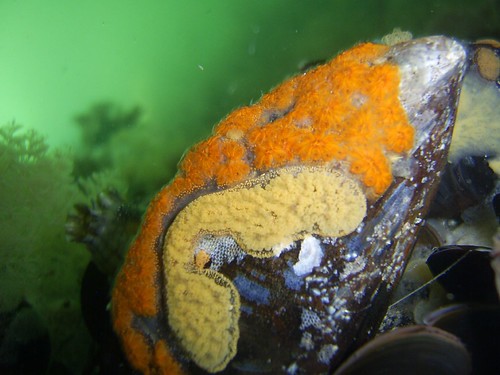
The real prize though was this female channeled whelk (Busycotypus canaliculatus formerly Busycon canaliculatus). Johann spotted her and pointed out the fact she was currently "laying" and egg case string. Soon after the animals were sorted into the tanks, the guide showed the whelk and explained the egg case string to the guests, then she carefully (more or less) dropped the whelk back into the sound.

The main reproductive time for the channeled whelks is the fall. Egg strings like the one this lady is laying will consist of 40-160 or more egg cases all joined by a tough leathery string. Each case may have as many as 100 eggs inside, though the average number of eggs per case is closer to 40. Not all the eggs in each case are fertilized though and the unfertilized eggs serve as food for the young whelks which emerge from the cases as miniature adults.

There is a small fishery for whelks here in the Long Island Sound, mostly sold in Italian markets as scungili. Unfortunately the most common bait used is chopped up horseshoe crab.

Saturday, June 6, 2009

Monday, May 18, 2009

Warty Sea Star


Warty sea star, originally uploaded by sbailliez.

Now this is a cool looking sea star!

Of course the questions start racing through the head -
What are the warts?
What purpose do they serve, if any?
Why are some distended from the body and others not?
Do the warts have pedicellariae ?

Chris?!?!
Help!!

Monday, February 23, 2009

Monday Movie: Pom Pom Crab (Lybia tessellata)

My perfect way to start the week would be a dive, but if I can't get in a dive, the next best thing is to enjoy a dive "virtually" (not nearly the same, but better than nothing!) So until I can go diving again on Monday mornings, I think I'll bring a dive video featuring some invertebrate, or invert community.

First up is the Pom Pom or Boxing Crab, Lybia sp., which carry around a pair of anemones (generally of Bunodeopsis or Triactis genuses) in their chelipeds. They use the anemone as a self defense weapon. Popular in marine aquariums, in the wild these crabs are found throughout the Indo-Pacific region, including a recently (2006) discovered species from French Frigate Shoals in the Northwestern Hawaiian Islands. Unfortunately br

This particular video was taken in Bunaken Marine Park, North Sulawesi, Indonesia, making the crab Lybia tessellata.

Tuesday, February 17, 2009

Waiting for the Spring


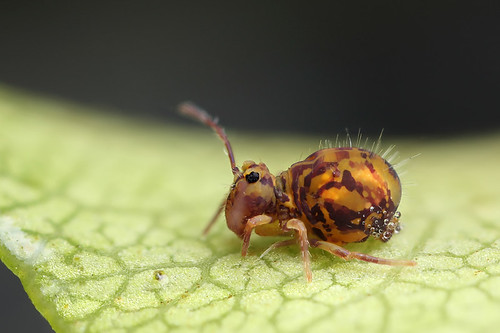
bubble bum springtail, originally uploaded by Lord V.

A wonderful image of Dicyrtomina ornata, a springtail showing the eyes, and if you look carefully under head, the furcula just touching the leaf between the first and second pair of legs.

Monday, January 12, 2009

Wild Hoppers!

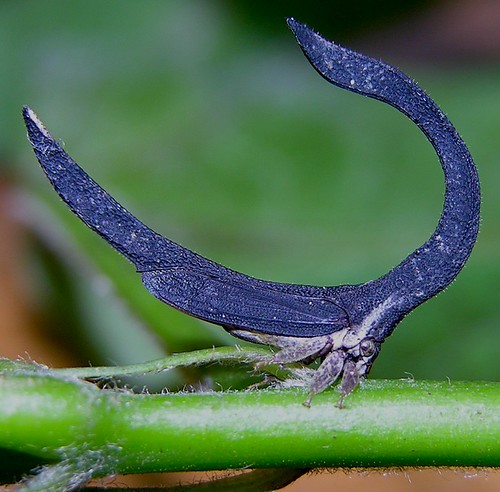
Cruising through a few of the recent images uploaded by Artour_a at Flickr and I ran into this beautiful treehopper. I remember some real oddities when I was in Honduras, but this one is a real winner!

Artour_a has quite a few tropical tree hopper images on his site in a great set called...hmmm. what was it called? Oh, yes - Treehoppers:

Monday, December 8, 2008

Invert Credit

Kevin just sent me an email about a blogger both of us have followed for some time - dalantech of the No Cropping Zone - a very talented macro photographer. (I love his deconstructions!)

December Drone by *dalantech


In his latest post he has offered that he often will license his insect images for credit only, especially for a science or education professional. As he says it works for him to get the publicity and for the professional to get some wonderfully high quality images.

If you need good insect macro photography for your next pub or presentation give him a once over. Some excellent material in his galleries.

Now to get some CC licensed mollusc photos...f course I'd rather take them myself, but no time... (and few animals)

Tuesday, December 2, 2008

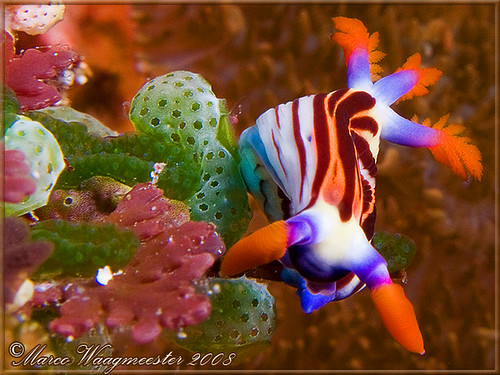
Random Invert Picture - Nembrotha aurea

The photographer id's it as Nembrotha purpureolineata but the orange dorsal patch looks to me more like it is Nembrotha aurea as described in

Marta Pola, J. Lucas Cervera, Terrence M. Gosliner (2008). Revision of the Indo-Pacific genus Nembrotha (Nudibranchia: Dorididae: Polyceridae), with a description of two new species Scientia Marina, 72 (1) DOI: 10.3989/scimar.2008.72n1145

Thursday, October 23, 2008

Misunderstood


Sticky Situation, originally uploaded by fiznatty.

For this week's Life Photo, an organism that has gotten quite a bit of press today, but that I fear will only exacerbate the common misunderstanding of it's kind that is prevalent in our society. Above is a beautiful golden silk orb weaver spider of the Genus Nephila. These spiders can grow to be pretty large (for the Nephila clavipes above, up to 40mm long) and love to spin (their genus name means spin lover) beautiful webs often with reinforcement threads in them that zig-zag back and forth looking a bit like a runway for small flying insects to follow to the center. As with many spiders they are not aggressive towards humans and their venom is not toxic. Orb weavers are pan tropical with N. clavipes, reaching into the southern U.S. Heck I really wish we could find them here in Connecticut. Maybe in another 25-30 years.

So what is the news that may exacerbate the misunderstanding of this species?

Welll, it seems that at least one of the Nephila species wanted to see the invert vs. vert series brought back and figured the best way was to show how an real invert can take on a much larger vertebrate:


Of course this is getting much play across the net, most of it remarkably good, but some reactions of fear and loathing.

Classification for the orb weaving spiders

Kingdom
Animalia

Phylum
Arthropoda (crustaceans, insects, spiders & related)

Subphylum
Chelicerata

Class
Arachnida

Order
Araneae (Spiders)

Family
Araneidae (orbweavers)

Genus
Nephila

Friday, October 17, 2008

Freshwater Ostracod


Freshwater Ostracod, originally uploaded by eclectic echoes.


Time for an ostracod portrait! This is one of around a hundred ostracod (I believe they are of family Podocopida) that were saved from one a small tank that we tore down this week. I had to make sure we saved a few of them to seed the remaining tank – which I have never seen even a single ostracod in (until now!)

These particular ostracod have a very cyclical lifestyle in the tank which makes me wonder if they might have originated in vernal pools. We see the ostracod predominantly from September through June, when hundreds can be counted in very short order. In July and August I only a small handful can be found, even allowing far more time.

You can find out more about ostracods including their bioluminescent dances and their connection to the Nobel Prize, (truly fascinating buggers, very important to paleontology too) at:

The Other 95% - Ostracod Posts
Evolutionary Novelties - The OstraBlog Posts

As a side note, I think I have finally got a rig for taking pictures through he scope figured out. Actually it's not a rig yet, but now at least I can fabricate a mount so I can have the camera securely connected to the scope.

Classification

Kingdom
Animalia

Phylum
Arthropoda

Subphylum
Crustacea

Class
Ostracoda

Order
Podocopida

Saturday, October 11, 2008

Cellar Spiders


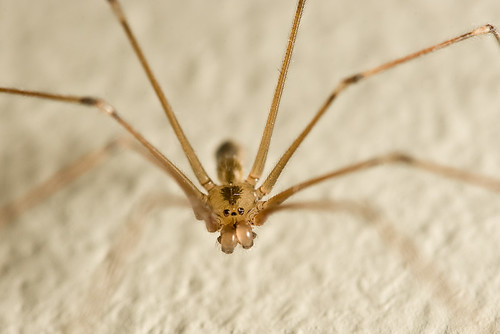
Longbodied Cellar Spider
Longbodied Cellar Spider, originally uploaded by eclcticechoes.


When I think of spiders I typically think of either the orb weaver spiders with their beautiful webs or tarantulas and trapdoor spiders that line burrows with layers of silk. Comparatively the cellar spider's web is a downright mess, lines going every which way, no order, random chaotic (hmmm...a bit like my desk!).

The time of year has come in New England for the cellar spiders of the family Pholcidae to show up in the house. A family with some 1000 species and a truly worldwide distribution these spiders are often referred to as "daddy long legs" which Christopher explains is an absolutely useless name since it is applied to many diverse groups of animals including our friends the harvestmen, which Christopher explains is . The one above is the Longbodied Cellar Spider (Pholcus phalangioides). This one was drunkenly admiring the art, but when the paparazzi attacked it decided to take a break from visual arts and engage in some culinary arts hiding behind the recipe books in the kitchen.

I say "drunkenly" since when these spiders walk about on the floor they often bob and weave as if they are one of the late night drunks headed past my house on a Saturday night. Their walk is not the only interesting motion of theirs. If disturbed in their webs they will begin vibrating wildly, seeming to dance. It does make them at times hard to track so I can see where this would work as a defensive maneuver.

Anyone know the meaning of "phalangioides"?

Classification for Ctenocephalides felis

Kingdom
Animalia

Phylum
Arthropoda

Class
Arachnida

Order
Araneae

Family
Pholcidae

Genus
Pholcus

Species
Pholcus phalangioides

Saturday, October 4, 2008

The Ignoble Fleas


I always love closeup shots of the the inverts, great macro shots or SEM's like this one.

Couple that with excellent Ignoble Award winning research such as Marie-Christine Cadiergues, Christel Joubert, and Michel Franc of Ecole Nationale Veterinaire de Toulouse, France who discovered that the fleas that live on a dog can jump higher than the fleas that live on a cat.

M.C. Cadiergues, C. Joubert, and M. Franc (2000) A Comparison of Jump Performances of the Dog Flea, Ctenocephalides canis (Curtis, 1826) and the Cat Flea, Ctenocephalides felis felis (Bouche, 1835). Veterinary Parasitology, vol. 92, no. 3, October 1, 2000, pp. 239-41. DOI: 10.1016/S0304-4017(00)00274-0

Classification for Ctenocephalides felis

Kingdom
Animalia

Phylum
Arthropoda

Class
Insecta

Order
Siphonaptera

Family
Pulicidae

Genus
Ctenocephalides

Species
Ctenocephalides felis

Saturday, September 27, 2008

Sea Squirt Sperm Races


Botrylloides and Botryllus, originally uploaded by top.down.

Miriam at the Oysters Garter has an hilarious and informative post up about a quite serious subject, sperm size and reproductive success in broadcast spawners. Yes, size does matter! So does speed and quantity and...

The image above is from a researcher where I work study showing Botrylloides and Botryllus species of Urochordata. While neither Botrylloides nor Botryllus are endangered, (the topic of this weeks Life Photo Meme) these invasive colonial tunicates are endangering other benthic organisms. Of course the urochordata sexual habits have been discussed here before...

Classification for Botryllus schlosseri

Kingdom
Animalia

Phylum
Chordata

Subphylum
Urochordata

Class
Ascidiacea

Order
Pleurogona

Family
Botryllidae

Genus
Botryllus

Species
Botryllus schlosseri

Monday, September 22, 2008

Life and Death through the Macro Lens

Life and Death of Aphids
Aphid life and death, originally uploaded by Lord V.

LordV on flickr captured this scene of life and death on the micro scale. A wingless aphid (possibly Toxoptera citricida)gives live-birth to a nyph that was developed through parthenogenisis (unfertilized egg). Right beside her is the remains of another aphid who was the victim of a parasitic wasp (which may itself reproduce pathenogenetically).

The wasp injects her eggs into aphids, often directly in front of any guardian ants. When the wasp egg hatches the larva eats the aphid from the inside, hollowing out a space to pupate within at the same time. Once metamorphosis is complete, the adult wasp cuts a circular hole in the tail end of the aphid husk to facilitate it's eclosion.

I recommend spending a little time looking at LordV's flickr stream. He is a talented macro photographer, mostly with insects and arachnids as his subjects. (Though his flowers-in-a-dewdrop photos are also great.)

Thursday, September 18, 2008

Wilted Greens


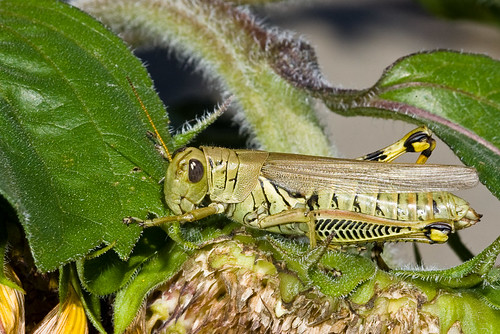
Did you know that the Differential Grasshopper (Melanoplus differentialis) prefers wilted or damaged sunflowers? This one is seen on a sunflower that was damaged in recent winds we had here (tail end of Hanna). I wondered why it was that the grasshoppers (2 found) and the evidence of grasshopper activity – chewed leaves and copious amounts of feces – was all on the damaged sunflowers and not on the still healthy plants.

In 1984, A. C. Lewis published a study in Ecology which showed M. differentialis has a strong preference for wilted and damaged sunflowers. In Feeding choice trials only 1% of grasshoppers feeding on undamaged sunflower tissue when damaged or wilted tissue was available as well. The wilted leaves have higher sucrose and soluble amino acid concentrations.

In growth trials, grasshoppers which fed on mixed diet of both damaged and healthy sunflower tissue had a higher growth rate at all stages, higher fecundity, and higher survival. Grasshoppers fed only fresh healthy leaves had slower consumption rates, lower food conversion efficiency, and interestingly also had a higher feeding rate of molted skins.


The higher survival and fecundity rates may be because of the difference in diet directly, but it is likely that in part these are a result of the higher growth rate of the instar stages and increased size and health of the adults. (Bigger healthier females -> more eggs, and more robust eggs)


Classification of the Differential grasshopper:
Kingdom
Animalia

Phylum
Arthropoda

Subphylum
Hexapoda

Class
Insecta

Order
Orthoptera

Suborder
Caelifera

Family
Acrididae

Genus
Melanoplus

Species
Melanoplus differentialis


References:
A. C. Lewis (1984). Plant Quality and Grasshopper Feeding: Effects of Sunflower Condition on Preference and Performance in Melanoplus Differentialis Ecology, 65 (3), 836-843

Thursday, September 11, 2008

Clean up time!

Mark your calendars down for the 20th of September for International Coastal Cleanup Day. Donate a couple hours to helping to clean up the beaches and waterways of litter both above and below the waters surface. In my own area there will be at least three separate efforts including one sponsored by the University's EcoHusky and diving clubs. Other local efforts are being sponsored by the local nature center and the Mystic Aquarium.

To find out what groups are organizing in your area you can register as a volunteer, or contact your local US coordinator (pdf) or international coordinator (pdf) directly.


Trashed Home
A hermit crab found Alex and I found on Southwater Caye in Belize using a bottle cap as a shell. Of course this is indicative of a two fold problem.

#1 - a lack of available size-appropriate shells caused in part by increased shell collecting
#2 - too much trash available

Classification of the Caribbean Hermit or Tree-Climbing Crab:
Kingdom
Animalia

Phylum
Arthropoda

Subphylum
Crustacea

Class
Malacostraca

Order
Amphipoda

Suborder
Decapoda

Family
Coenobitidae

Genus
Coenobita

Species
Coenobita clypeatus


Wednesday, September 3, 2008

Right Whale Lice


Cyamus ovalis Photo: Vicky Rowntree, University of Utah

In an earlier post, I joked (well half joked) about the need to save the whale lice, even if you don't care about the right whales. I thought today I would expand on the brief comment about the lice and their special relationship with whale and how they can actually tell us about the populations of right whales and their evolution.

Image courtesy of Mariano Sironi, Institute of Whale Conservation, Buenos Aires

In the image above you can see the characteristic white and black rough patches known as callosities on the face of a right wale. The raised dark grey bits are indeed part of the whale. Those are rough ridges that become sharper and harder. They are not really lice, but a caprellid amphipod, in other words a crustacean. Whale lice specifically are in the family Cyamidae consists of 35+ species in seven genera and are collectively known as cyamids.

On each right whale around 5000 Cyamus ovalis coat the callosities and gives them their white color is Cyamus ovalis. In the spaces between the raised callosities live around 500 C. gracilis. On adult whales approximately 2000 C. erraticus live in the genital and mammary slits. C. erraticus is highly mobile though often occupying wounds, and living in large concentrations on the heads of young calves. Of these C. gracilis is the smallest with ~6mm long adults and with the other two species measuring ~12-15mm long as adults.

Closeup of Right Whale callosity with C. ovalis. From Iain Kerr, Ocean Alliance/Whale Conservation Institute

The cyamids were named "whale lice" by early whalers in reference to their own head and body lice. Mmmmm fun! While not actual lice, they behave similarly in a few key ways. Cyamids have no free swimming stage and spend their entire life on one species of whales, transferring from whale to whale through intimate contact, primarily between a mother and it's calf. They were recently used, similarly to their lice namesakes, to track the population structure and evolution of their hosts.

In 2005 a team of scientists published the results of their study of the population structure and evolution of right whales based on DNA studies of the whales' cyamids. The cyamid DNA is in some ways more informative than the whales' own DNA as the cyamids complete many generation per whale generation and the population of the cyamids, especially C. ovalis, is far greater than that of the whales, offering the researchers more mutations to track.

The team collected cyamids from globally distributed right whale strandings and used variation in the mitochondrial COI gene to analyze the population structures of both the cyamids and by inference the right whales they inhabit. The first finding was that there was no obvious population structure within ocean basins. They also found high levels of haplotype diversity but low gene differentiation suggesting a large population with high transfer rate between individual whales.

The North Atlantic and Southern Ocean populations however have apparently been fully isolated for several million years. This supports the view that the North Atlantic, Southern Ocean and North Pacific right whales have been isolated for millions of years and shouldbe considered separate species. In a gene tree for the right whale cyamids the three different nominal species clustered out as seven distinct species. C. avalis, C. gracilis and C. erraticus fall out with separate North Atlantic and Southern Ocean species which diverged approximately 6.3mya. Interestingly the Northern Pacific C. ovalis form a tight clade nested within the tree of the Southern Ocean C. ovalis suggesting that there was more recent contact those two populations than between the Northern Atlantic and Southern Ocean populations.

By studying the cyamid crustaceans Jon Seger and his team were able to provide another line of evidence that each oceanic basin population of right whales is in fact a distinct species. They also found four new species of right whale cyamids and that the number of right whales in each basin was higher than originally estimated for pre-commercial whaling populations.

Classification of the nominal species Cyamus ovalis:
Kingdom
Animalia

Phylum
Arthropoda

Subphylum
Crustacea

Class
Malacostraca

Order
Amphipoda

Infaorder
Caprellida

Family
Cyamidae

Genus
Cyamus

Species
Cyamus ovalis


References:
Kaliszewska et al. (2005). Population histories of right whales (Cetacea: Eubalaena) inferred from mitochondrial sequence diversities and divergences of their whale lice (Amphipoda: Cyamus) Molecular Ecology, 14 (11), 3439-3456 DOI: 10.1111/j.1365-294X.2005.02664.x

Thursday, August 28, 2008

Ancient Opiliones


Harvestman
Harvestman, originally uploaded by eclectic echoes.

Not so long ago Chris at Catalogue of Organisms decided to devote the next few years of his life to sorting out the nomenclature of the long-legged harvestman, a task that he admitted was prone to make him
Run screaming in horror from the entire concept of Asian Gagrellinae and end up crouched into the fetal position and whimpering in the darkest recesses of the wet collection.
You gotta respect a man who can take on his deepest fears like that (either that or prepare to offer him round-the-clock in-house meds, nursing and security).

I can't offer much about the harvestmen, except the most basic tidbits. While harvestmen are arachnids like spiders, they are not spiders, but belong to a sister group (order Opiliones) of the spiders (order Arenea). The most immediate visible difference between harvestmen and true spiders is the appearance of the body: spiders have a clearly defined two part body form consisting of a cephalothorax and an abdomen separated by a "waist", while harvestmen have a body in which the two sections appear fused into one oval shape.

Contrary to popular myth, Harvestmen pose no danger to humans, not because they can't pierce human skin (which all but the largest species can't, but that's beside the point), but because they have no piercing "fangs" and no venom glands. In the image you can clearly see the chelicerae, which have no piercing structures, unlike the true spiders.

Last tidbit...the Opiliones are an ancient group and have left some interesting fossils, including a 400 million year old fossilized penis. The oldest penis second oldest known penis known in fact.

The current and previous record holders? The Ostracod.

Update: I was wrong about the current record holder for the oldest known male genitals... not 3 months after the 412 Myo fossil harvestman was documented, a 425Myo Ostracod was documented with well preserved male member.

Friday, August 22, 2008

Danaus plexippus Egg Mk. III


Monarch Butterfly Egg
Egg Mk. III, originally uploaded by eclectic echoes.

Egg Mk. I
hatched outside, but the caterpillar disappeared when only 1-2 days old (presumed eaten)

Egg Mk. II I believe was the victim of a parasitic wasp or fly. Under the scope the yellow mass outside the empty egg looks to be the remains of a caterpillar that has exploded(?)

But, Tammy brought in two eggs from the recent layings (and the leaves they are on) so hopefully this one will develop normally and then we can get pictures throughout its development. Of course this may forever scar the young caterpillar and have it following paparazzi flashes instead of nectar.

The plan is for my son to track the development with measurements of the caterpillar as well as the amount of food it eats etc. He has raised butterflies in the past, including monarchs but this time Tammy may make a more formal project of it.

Of course I get to get pictures hopefully!

Right now the egg is literally just a speck. This shot (a 1:1 pixel crop in the large size) was with a 100mm Macro, a 1.4x teleconverter and 48mm of extension tubes. The egg itself is just .02" in diameter.

Kingdom
Animalia

Phylum
Arthropoda

SubPhylum
Hexapoda

Class
Insecta

Order
Lepidoptera (Butterflies and Moths)

Family
Danaidae (Milkweed Butterflies

Genus
Danaus

Species
Danaus plexippus

Sunday, August 17, 2008

Red King Crab Zoea - Paralithodes camtschaticus


Alright, this is not my picture (Again! Gotta get out and get more invert images!) but I've been a bit under the weather.

Anyways, the current Life Photo Meme is "Free"... well, these tiny red king crab (Paralithodes camtschaticus) zoea aren't going to go free, but if the program they are part of works out like people are hoping, there might be many more of them going free in a few years with a hopeful rebound in stocks.

These zoea are part of the Alaska King Crab Research, Rehabilitation, and Biology (AKCRRAB) project in Alaska, a collaboration of industry, local, state, and federal groups to conduct research aimed at hatching and rearing wild red and blue king crabs in large scale hatcheries to a stage where they can be released into the wild and contribute to reversing low wild stock abundance in Alaska.

The program is in its second year, with two successful red king crab hatches. University of Alaska Fairbanks graduate student Celeste Leroux has been conducting experiments to evaluate diet, culturing, density, and other parameter effects on larval growth and survival. Considering that they are highly cannibalistic in the early stages of life, one of the big hurdles will be learning how to maximize survival, while keeping large numbers of the larval crabs.

Classification of the red king crab:
Kingdom
Animalia

Phylum
Arthropoda

Subphylum
Crustacea

Class
Malacostraca

Order
Decapoda

Infaorder
Anomura

Family
Lithodidae

Genus
Paralithodes

Species
Paralithodes camtschaticus (Tilesius, 1815)