Tiny Friends
We found an ootheca recently, and brought it in to watch the hatching of 85+ tiny (less than 1cm long) mantids. They have now taken up residence in the garden hopefully keeping the early spring aphids at bay.

We found an ootheca recently, and brought it in to watch the hatching of 85+ tiny (less than 1cm long) mantids. They have now taken up residence in the garden hopefully keeping the early spring aphids at bay.
 MIT Technology Review has an interesting article on Army research to remotely control a beetle's flight path via a neural microchip implant. Don't believe me? Check the video. Its fascinating!
"The beetle's payload consists of an off-the-shelf microprocessor, a radio receiver, and a battery attached to a custom-printed circuit board, along with six electrodes implanted into the animals' optic lobes and flight muscles. Flight commands are wirelessly sent to the beetle via a radio-frequency transmitter that's controlled by a nearby laptop. Oscillating electrical pulses delivered to the beetle's optic lobes trigger takeoff, while a single short pulse ceases flight. Signals sent to the left or right basilar flight muscles make the animal turn right or left, respectively."Hat tip to mocost via Twitter.
A cool story developing about researchers who found a species of dung beetle that switched diets somewhere along its evolutionary history. From farmer to predator, the little bugger uses its hind legs for grappling with the millipedes while decapitating them with its jaws. These are the same hind legs used all other dung beetles for rolling dung into balls and the same jaws that once extracted bacteria from piles of dung...
It's a fascinating story at the BBC with a video of the act!
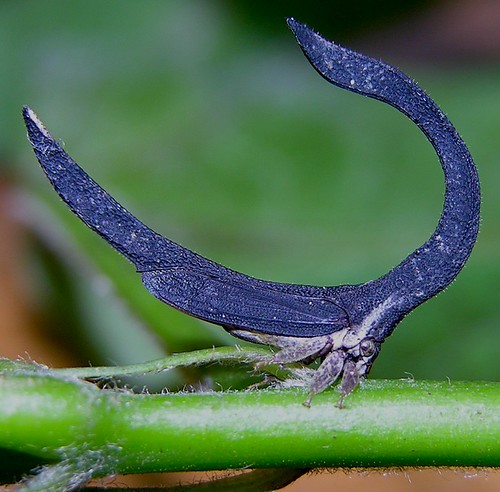
Cruising through a few of the recent images uploaded by Artour_a at Flickr and I ran into this beautiful treehopper. I remember some real oddities when I was in Honduras, but this one is a real winner!
Artour_a has quite a few tropical tree hopper images on his site in a great set called...hmmm. what was it called? Oh, yes - Treehoppers:
From National Geographic's Youtube Channel:
Happy Holidays everyone! Its been great having you all as readers and participators in this blog for the 2nd year! Enjoy this short stop-motion video of an Insect Christmas by Vladislav Starevich. As the NC State Insect Museum notes, beware of the dubious taxonomy and just be amused by somersaulting insects.
I love this video of Euglossine bees pollinating the brazilian orchid, Catasetum macrocarpum.
From the WebEcoist:
These deadly insects are naturally designed to kill. The effects of their bites range from painful to deadly for humans, and they inject their prey with lethal salivary secretions that immobilize them and ease ingestion and digestion. These six represent some of the stranger and more interesting assassins of the insect world.

LordV on flickr captured this scene of life and death on the micro scale. A wingless aphid (possibly Toxoptera citricida)gives live-birth to a nyph that was developed through parthenogenisis (unfertilized egg). Right beside her is the remains of another aphid who was the victim of a parasitic wasp (which may itself reproduce pathenogenetically).
The wasp injects her eggs into aphids, often directly in front of any guardian ants. When the wasp egg hatches the larva eats the aphid from the inside, hollowing out a space to pupate within at the same time. Once metamorphosis is complete, the adult wasp cuts a circular hole in the tail end of the aphid husk to facilitate it's eclosion.
I recommend spending a little time looking at LordV's flickr stream. He is a talented macro photographer, mostly with insects and arachnids as his subjects. (Though his flowers-in-a-dewdrop photos are also great.)
I was cruising the BBC Motion Gallery web site for some clips and I came across this one of locust love.


 Life Photo Meme
This may be the ultimate ecosystem service. The NC State University Insect Museum blog reports from a new study that calculated the worth of insects to agriculture:
"Looks like insects' total contributions to agriculture amount to €153,000,000,000 ($216,372,000,000), which is almost 10% of the value of all human food worldwide."O M G That is some serious figures! Go to the NC State Insect Museum blog to get the details and the link to the study. Bookmark it too, it is an excellent blog!
Hat Tip to Bora for finding this gem. I couldn't really call it an invert or vert win or lose since no one died or was seriously maimed in the conflict. Lets just call it cool!
A nice appreciation of the Fruit Fly in science and the public's view of them set to a nice soundtrak! Tip of the curly wing to Bjorn Brembs.
From ECOLOG:
The University of Maryland College Park, MD
Graduate research assistantships starting in the Fall 2009 are available under the supervision of Paul Leisnham in The Department of Environmental Science and Technology (ENST). Research will focus on the effects of anthropogenic environmental changes, such as climate change, land use change, and species invasions, on the ecology of disease-vector mosquitoes in water-filled containers, wetlands, and stormwater systems.
This is a chance for high-caliber students to work closely with their supervisor in a topical and important research area. Successful students will undertake innovative research that will both enhance current management of vector mosquitoes and improve our understanding of fundamental ecological issues, including life-history trade-offs, phenotypic plasticity, and community interactions. Opportunities exist for students to develop their own research ideas in consultation with Dr. Leisnham. Successful applicants will have a strong academic record and prior experience in ecology or entomology. Assistantships are fully-funded and include an excellent living stipend, tuition remission, health benefits, and funding to cover research expenses, including travel.
ENST administers a cutting-edge multi-disciplinary graduate program that addresses issues at the interface of ecosystem and human health. ENST has world-class field and lab facilities. The close proximity of ENST to federal institutions and facilities, including NIH, NSF, USDA Beltsville, and the Walter Reed Army Institute, presents excellent opportunities for students to collaborate and connect with future employers. For more information on ENST: http://agnr.umd.edu/departments/enst/. College Park offers a diverse, vibrant college experience, as well as excellent outdoor pursuits nearby and the city experiences of Washington DC and Baltimore.
Interested students should email Dr. Paul Leisnham (pleisnh{at}ilstu{dot}edu) to discuss research goals and project ideas well before the application deadline (i.e., August 2008 onwards. The application deadline is 1 February 2009).