Nature Blog Network
Showing posts sorted by relevance for query Sea Squirt. Sort by date Show all posts

Friday, December 21, 2007

Sea Squirts, SLOSS and of Course Porn

Blogging on Peer-Reviewed ResearchCastilla et al. (2007) are reporting in a recent PNAS article an interesting property of sea squirt pornography and local oceanography. I know, I'm a frequent purveyor of tunicate smut, but this utter filth may have consequences in the debates surrounding marine reserve design. These authors studied the spawning behavior of intertidal tunicates (Pyura praeputialis, an invasive) from chilean coasts. What they found will make all decent folk turn their insides out. These filthy denizens of the seas let it all out together in a mass orgy. Oh the indecency. Are you sure the children are asleep and not watching over your shoulder? You may want to tuck them in before continuing on.

Sea squirts have mobile "tadpole"-like larvae whose role is typically dispersal since they do not feed. The also don't stay in the water column for too long, preferring to stick their heads to a rock somewhere (figure below shows larval metamorphosis).


So what happens when tunicate sperm and egg meet seawater? An explosion of bio-foam! This foam is created by surfactants in Pyura's gametes (see figure below). This reduces the surface tension of the seawater. So basically, sea squirts spawn en masse, the high amount of gametes in tidal channels releases a high amount of surfactants which react with the seawater and its associated protein debris creating foam, the surface tension is reduced so larvae are not carried out to sea, thus larvae are retained in the tidal channel! As simple as that. Castilla et al. (2007) document the effects this foam might have on larval dispersal ability by monitoring ping pong balls in the channels. When there is no foam present, they all head out the channels to sea. When foam is present, 50-60% of the ping pong balls were retained in the tidal channel (depending on ebb or flood tidal conditions).

A) Mass splooging of P. praeputialis. B) Sperm (SS) and egg (ES) suspensions left dripping in the intertidal. C) 2 meters of foamy splooge. D) Chilean researcher knee-high in sea "squirt" if you know what I mean... Fig. 1 from Castilla et al. (2007).

So what is the end result of this filthy, spineless mass bukkake? (That ought to bring in the hits!) Larvae are retained in the tidal channels resulting in massive colonies over several generations. They are not trapped here though since theoretically, as shown with the ping pong ball experiment, nearly half of the larvae escape out to sea where they can start new colonies in other tidal channels perhaps. But this suggests that other larval forms are also retained during foamy times. Hence this bio-foam acts as resistor to the current of larvae out of a particular channel.

This has some interesting connotations for the ever debatable Single Large Or Several Small (SLOSS) dilemma facing marine reserve designers. If rare or endangered species occur in such tidal channels, for instance, you would want to grant protection to that channel. It is acting as quasi-reservoir for recruitments. Populations would appear to build up in these channels (excluding all other ecological forces that determine population size like competition, resource availability, etc.) and proportionally send out more larvae with each generation. This research suggests that protecting individually foamy channels (those with gametes secreting surfactants, or channels with high protein debris content) would more sufficiently protect the potential source of larvae for a particular species of interest. You just need to find the right areas, the foamy ones.

Of course this opens up a lot of questions. As someone interested in communities and diversity. I would like to understand how surface tension reduction affects the structure and composition of communities in foamy channels and compare that to non-foamy channels. Or, how planktonic communities respond to this potential stress? Does the composition of the seston track the cyclic patterns of the foam production and tides? Is diversity higher in non-foamy channels because foamy ones tend to have a higher dominance (and lower evenness) of a few species like Pyura praeputialis. Does the foam and reduced surface tension, act a barrier to immigration for new species and recruits? Its a pretty interesting system and though I don't know the foam literature well, I get a sense that this isn't well-studied. I will be looking for a postdoc very soon.... (hint hint).
____________________________________________________________________
Castilla JC, Manriquez PH, Delgado AP, Gargallo L, Leiva A, Radic D (2007) Bio-foam enhances larval retention in a free-spawning marine tunicate. Proceedings of the National Academy of Sciences 104:18120-18122. doi:10.1073/pnas.0708233104

Friday, September 7, 2007

Revelations: How My Readers Are Finding Me

I like Statcounter. Its a very useful, free counter that tells me lots of interesting things about the people that come to my site. One of these interesting things is that I can see what websites people come here from and what keywords people use to find my site on a search engine. As you all know I wrote a post on the promiscuity of a certain sea squirt titled Sea Squirt Chics Have No Inhibitions. Which also inspired my one hit wonder Sea Squirts Just Want to Have Fun. I have been getting some, not a whole lot, but more than a few hits a week to my website by people searching "squirting chics" or variants of those two words.

Click to enlarge


I find this highly revealing about my readers. I'm not quite sure what to make of my website being listed alongside "Ejaculating Women Videos", a "How to squirt loads" forum, femaleorgasmsrevealed.com, etc. I guess sex sells right? So am I just another purveyor of perverted invertebrate pornography?

Tuesday, February 26, 2008

A Protocol for Sea Squirt Dissections

Our biology department has been having a lot problems keeping sea urchins alive here in landlocked central PA. Probably mostly from poor keeping, but they seem to be very sensitive to our wide temperature fluctuations (i.e. purple California sea urchins hate PA winters). As a back up we would like to use another organism when our urchins die off, possibly a Ciona species. Does any sea squirt biologists (Jarrett, Miriam?) have a protocol for dissecting gonad our of sea squirts? It is for a development lab. Please leave or a comment or email me (address in top right sidebar).

Saturday, February 28, 2009

What Google Says

In an interesting Navel Gazing and Social experiment Rick MacPherson of Malaria, Bedbugs, Sea Lice & Sunsets came up with a meme finding a number of search terms (other than the blog title) that result in a #1 google ranking for the blog. Somewhat predictably MBSLS came up # 1 on such searches as “coral reefs, conservation, queer” and "moray, rick". Somehow it also came up as the number one place to turn for “zelnio, conservation, blog, coral, drunk”.

I know Kevin and I long ago evolved into more or less responsible drinkers, but this is devastating news. Even though he is a friend, that's some important territory we need to win back from Rick. Kevin, we gotta do more drunk blogging about inverts and conservation! ;-)

Ok, while the scallop beer and lobster vodka chill, I'll respond to Rick's meme tag. It's a great excuse to procrastinate doing mindless GIS exercises.

First search is the obvious one:

  1. "zelnio heupel" or is that "heupel zelnio" #1 either way (yes, with google sometimes word order does matter)

  2. "chaetognath phylogeny" beat out some heavy hitters like the Tree of Life, Springerlink, and Oxford Journals.

  3. "barnacle evolution" scored another top spot with Kevins awesome tribute to Alan J. Southward and summary of a great paper on Barnacle Evolution

  4. "whale lice conservation" gets a nod as number one for the Quixotic mission to get Right Whale Lice listed as an endangered species

  5. the "Nobel Jelly" surprised me with a number 1 spot as well

  6. But then things get a bit weird:
  7. "sea squirt porn" a search phrase that also consistently shows up in our logs...weird! There must be a lot of lonely sea squirts out there tapping into the lab computers, or desperate tunicate researchers, or.. well I really don't want to know if it's not the one of the first two.

  8. "ostracod penis" got a top result, but not "ostracode penis" which only got a #2 result.

  9. "squirt en masse" was a number one result that I really don't even think I want to know about

  10. "sperm races" Beg pardon?! What? Oh, but that reminds me I need to set up the video to record those urchins, last time it was a photo finish


Looking through our logs some time ago I noticed "porn" was one of the top words that led people from Google to us so on a whim...I added "porn" to the end of a number of species we talk about and found out TO95% owns:
"whale lice porn" and "snail porn" with top ten results for "chaetognath porn", "mollusc porn", "cephalopod porn" and "arthropod porn". Interestingly Pharyngula beat us out on all of those except "arthropod porn" where Blackwell Synergy stomped our telsons.

So to be a meme it has to be self replicating...so if they would like to participate, I'm asking The Brine Queen, Bobbie and Jerry, Jason and Peter to gaze into their navels through Google and see what floats to the top.

Tuesday, July 24, 2007

Sea Squirt Chics Have No Inhibitions

Photo of Botryllus schlosseri from the Swalla Lab website

Yeah thats right they get it on with any male gamete that passes there way. They just give a [rhymes with duck]. Boom chaka-laka-boom. These loose lizzies are all about increasing genetic diversity if you know what I mean. OH, I know you know what I mean!

In the latest Molecular Ecology, Johnson & Yund, explore the promiscuity of tunicates (In order to preserve my somewhat kid-friendly stature, I won't even go into all the possibilities with sea squirts...but feel to in comments!). I like this study, not only for its obvious connotations, but because multiple paternity in a sessile critter is an interesting and fundamental research question. Most studies of promiscuity have focused on mobile fauna. But the uncanny Urochordata, Botryllus schlosseri, has another interesting facet, it alternates between being male and female, with no storage of sperm. Yeah, thats right. Being male is just a phase that Tunicates go through. But this does pose an interesting question.

Johnson & Yund used molecular tools, such as DNA microsatellites and sperm haplotyping to investigate the role of multiple paternity using three measures
1) minimum number of fathers, based on paternal allele frequency from embryos
2) number of sperm haplotypes
3) effective paternity, based on the number of unique sperm haplotypes

They found 15 sperm haplotypes and no effect of local or population level density on any of their measures. I find this interesting because common sense would appear to dictate that colonies would show skewing of sperm haplotypes towards males that are closest to the embryos of the females being sampled as opposed to sperm that has had to travel farther, hence becoming more diluted or fertilizing females closer by, etc. But this doesn't appear to be the case with Botryllus schlosseri from Maine's Damariscotta River estuary.

"The left side of a zooid of Botryllus schlosseri. The center of the system is to the right. Redrawn from van Name (1945). The North and South American ascidians. Bull. American Mus. Nat. Hist. 84:1-476, 31 pls." Taken from Invertebrate Anatomy Online.


So the punchline is that a whopping 90% of broods (using the most conservative measure) have multiple fathers. In fact, the smallest effective paternity from any one population was 2.4, meaning that there at least more than 2 fathers for each brood. Conversely, the highest effective paternity was 14.2! Woowee! Thats a virtual Orgychordata if you ask me! Keep in mind they only genotyped 15-20 embryos out of a potential pool of over 4,000 embryos in a broo.d. So I would definitely say that B. schlosseri is the slut of the invertebrates. But that is not without its potential advantages as outlined in the conclusion by the authors:
"Polyandry to increase genetic diversity is predicted to be favoured only (i) as a mechanism of inbreeding avoidance (ii) under situations of completely unpredictable environmental fluctuation (iii) when there is intense sibling competition, or (iv) when there is some cooperative or compensatory interaction among half-sibs."-Johnson & Yund 2007

Monday, August 6, 2007

Spineless Song Requests

Every Friday I've been posting a new Spineless Song for you the public to enjoy. I have no problem songwriting after a few rounds of my homemade Aquavit or my current beer of choice, Old Chub and Dale's Pale Ale from Oskar Blues Brewing Co. in Colorado. But I am now taking requests for this week's and upcoming Spineless Songs. So use the Post Comments Feature and request a song about your favorite invertebrate, feel free to suggest context, plot, lyric lines, etc. Anything goes so long as it Spineless. I am currently working on Sea Squirts Just Wanna Have Fun, related to my sea squirt post a week and a half back. Though parodies are great fun its time for a complete original.

Saturday, September 27, 2008

Sea Squirt Sperm Races


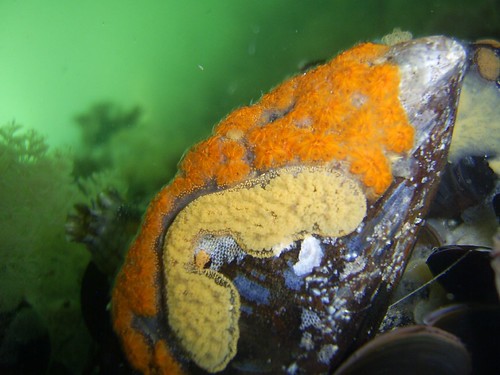
Botrylloides and Botryllus, originally uploaded by top.down.

Miriam at the Oysters Garter has an hilarious and informative post up about a quite serious subject, sperm size and reproductive success in broadcast spawners. Yes, size does matter! So does speed and quantity and...

The image above is from a researcher where I work study showing Botrylloides and Botryllus species of Urochordata. While neither Botrylloides nor Botryllus are endangered, (the topic of this weeks Life Photo Meme) these invasive colonial tunicates are endangering other benthic organisms. Of course the urochordata sexual habits have been discussed here before...

Classification for Botryllus schlosseri

Kingdom
Animalia

Phylum
Chordata

Subphylum
Urochordata

Class
Ascidiacea

Order
Pleurogona

Family
Botryllidae

Genus
Botryllus

Species
Botryllus schlosseri