Nature Blog Network

Friday, June 6, 2008

New Songs in the Sidebar!

There are 2 new songs uploaded in the Spineless Songs sidebar. Although neither are about the spineless hopefully you'll enjoy them nonetheless.

The top song is Drinking and Sailing. Information and lyrics for this new Kevvy Z original is at Deep Sea News since this song is part of my Deep Sea Ditties collection over there. The 2nd song is a brilliant, though sad, story about going to California to make a fortune so you can come back home and marry the woman you want. This was written by Dave Alvin, probably only the best songwriter evah!

Thursday, June 5, 2008

Bee Decline Linked to Introduced Virus

Editors note: Since Eric started this whole bee thing. I am posting this press release I wrote as part of a writing exercise for a job application for the NAS.

Extensive bee decline has the agricultural community in a panic. Bees are responsible for pollinating many crops and provide a service to the industry estimated at $15 billion a year. Diane Cox-Foster, professor in the Entomology Department, Penn State, and colleagues report in the journal Science a correlation between this decline, called colony collapse disorder (CCD), and Israeli Acute Paralysis Virus (IAPV).

CCD is diagnosed by an inexplicable disappearance of adults, leaving honey, pollen and grubs behind. Surveys detailed a loss of 50-90% of commercial bee colonies. The first reported declines were in 2004, corresponding to when the U.S. allowed imported bees from Australia. This study is the first report of IADV in the United States.

The study’s authors report that IAPV was only found in CCD hives and from Australian samples, but caution this may be part of a multifaceted attack including parasites, poor nutrition, pesticides and environmental stressors. Future research will study the role of IAPV in CCD in relation to these stressors.

The National Research Council report Status of Pollinators in North America concluded that populations of North American pollinators are in rapid decline. More than three-quarters of commercially important flowering plants need pollinators for fertilization. The honeybee is responsible for pollinating over 90 crops. Causes for the decline are difficult to determine due to inadequate data. The report recommended establishing a network with Canada and Mexico to form long-term monitoring projects, along with a comprehensive survey to gather baseline data for future population assessments.

NRC Report Status of Pollinators in North America

Other Resources:

• NAS press release: Some Pollinator Populations Declining; Improved Monitoring and More Biological Knowledge Needed to Better Assess Their Status
• Cox-Foster et al. (2007) A Metagenomic Survey of Microbes in Honey Bee Colony Collapse Disorder. Science 318 (5848): 283-287. Doi: 10.1126/science.1146498
AAAS teleconference with study’s coauthors (teleconference begins around three minute mark)

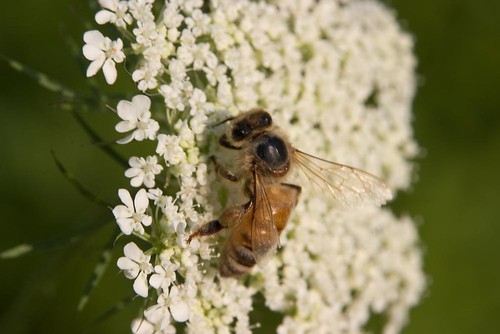
European Honeybee foraging


Honey Bee Hard At It

An Apis mellifera worker collecting some nectar. These poor bee's have had a bit of a time of it lately with Colony Collapse Disorder (CCD), but at least they can take solace in the knowledge that they can talk about it with their cousins the Asian honeybee. Or maybe not...depends on how well they remember... (and with which antenna!)

Although and introduced species, these bees are chief pollinators of over 100 commercially important crops (most of which are also introduced) and at least 1/3 of the American diet, giving these bees a value in the billions of dollars1 just from an agricultural point of view.


Kingdom
Animalia

Phylum
Arthropoda

SubPhylum
Hexapoda

Class
Insecta

Order
Hymenoptera

Family
Apidae

Genus
Apis

Species
Apis mellifera

Wednesday, June 4, 2008

International Communications - Dance It

ResearchBlogging.orgBee dancing has long been an interesting, if a bit controversial, subject for science with research articles focused on deciphering the meaning of dances, led by the pioneering work of Nobel Laureate Karl von Frisch. The essence of the dance is that successful foragers return to the hive and dance a figure 8. In the crossing section of the figure 8, the bee waggles its abdomen. The duration of the waggle section indicates the distance to the food source. The angle of the cross part (the tilt of the 8 if you will) indicates direction of the food source.

Now new Open Access research published in PLoS One looks at “international” communication capabilities between two species of honeybee: the eastern or asian honeybee, Apis cerana and the Western or European honeybee, Apis melifera. There are several species of honey bees that have been studied and each was observed as having a different dance style. To eliminate as many uncontrolled variables (primarily season, time, spatial scales, wind and geography of separate experiments) as possible, and be able to directly compare two species, a team of scientists from Australia, China and Germany creative a single hybrid hive with an A. cerana queen and a mixed worker population. They tried colonies with an A. melifera queen but in those colonies the A. cerana workers were killed and removed from the hive within 3 days. Even in the A. Cerana queened hybrid hives the team sometimes had to use active measures to keep the hive harmonious including spraying agitated bees with sugar syrup and honey water and removing troublemakers. Without active controls the hybrid hives lasted 20 days before the introduced workers were all killed or driven out, with active control the hives lasted in excess of 50 days. The harmonious hybrid hive also showed food transfer (trophollaxis) between species and mixed species workers tending the queen when she was laying eggs.

The researchers found that each species did have a distinct “dialect” primarily expressed in the duration of waggle to distance relationship. A. cerana bees waggled their butts significantly longer than A. melifera for all distances of food from the hive in both single species and hybrid hives. The team continued to evaluate understanding between the two species and found that the workers from either species were able to understand the dance of foragers regardless of the “dialect” of the dance and that the A. cerana were more likely to follow any successful forager than A. melifera. Both the direction and distance to the food source were accurately communicated between species.

Whats cool is that, as the researchers point out, this might be a social learning situation. Interspecific communication and potentially interspecific learning. It may be that if a longer term experiment can be successfully conducted, the two species of bees waggle durations may converge over a longer period.

Su, S., Cai, F., Si, A., Zhang, S., Tautz, J., Chen, S., Giurfa, M. (2008). East Learns from West: Asiatic Honeybees Can Understand Dance Language of European Honeybees. PLoS ONE, 3(6), e2365. DOI: 10.1371/journal.pone.0002365


Tuesday, June 3, 2008

New Carnivorous Genus described...


Via the Bleiman Brothers,
read their report at Zooilogix.

Circus of the Spineless #33!


Laurent at Seeds Aside just posted the latest edition of the Circus of the Spineless hot off the press!! Packed full with invertebrate fun, so gather round the family and tell the tales of dragonflies, snails, sea cucumbers and much much more.

Monday, June 2, 2008

Carnival of the Blue Lucky#13

The first Carnival of the Blue of its 2nd year. Carnie creator Mark Powell posts edition #13 and brings it all full circle with the most massive, packed ocean blogging. Its great to see so many diverse bloggers contributing to this carnival. Well, what are waiting for, go learn something!

Crustacean Crash

Critical Critter
Discovery News is carrying a news piece about the decline of a key great lakes species: Diporeia. This tiny crustacean, which feed primarily on planktonic algae, is eaten by many species of fish, importantly alewives (a type of herring) which are eaten by larger fish. The population crash coincides in general with the introduction of the Zebra mussel (Dreissena polymorpha) to the great lakes. Another clue that the zebra mussels are responsible (at least in part) is that the Diporeia are disappearing from all the lakes except Lake Superior which has a much lower population of zebra mussels - probably due to the lake's low calcium levels which the mussel needs to build its shell. The zebra mussels
... settle above the small crustacean's sediment homes and filter out algal plankton, which Diporeia must feed upon. They then leave behind copious amounts of waste -- literally defecating on the hapless crustaceans -- and transmit disease.


Vanishing Crustacean

Declining Diporeia
population density in
Lake Michigan

A shopping cart
covered by zebra mussel


Get the complete story at Discovery News...

Brokeback Bible: LMAO en espanol

My spanish-blogging spineless amigo, Diario de un Copépodo, has a funny post called Brokeback Bible. Mi gusta mucho the pictorial. If you don't speak spanish, you should be able to get the idea. The bible story in question is about David and Saul and exposes the blatant hypocrisy of bible believers and homophobia.

"Era rubio, de bellos ojos y hermosa presencia (He was blond, of beautiful eyes and beautiful presence)"-(Samuel 16:12)
Or if you prefer to see how the various versions of whatever bible covers up translates this go here.

Sunday, June 1, 2008

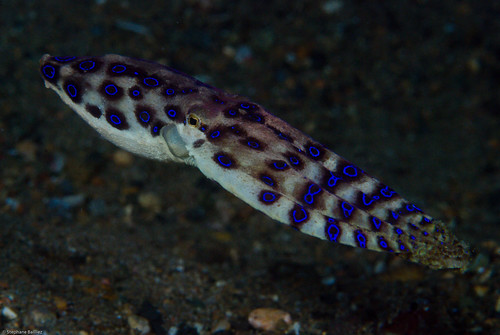
Cephalophilia #1 - Blue Ringed Octopus - H. lunulata


I thought a touch of cephalopod love on a beautiful weekend day. A nice example of one of the three genus of known toxic cephalopods: Hapalochlaena lunulata (Greater Blue Ring Octopus) from the Philippines. Highly toxic, they are rarely above 70g in size, but have enough toxins in them to deliver 20+ doses of toxin at lethal levels to an adult human. The chief component of their toxin is the same compound at the heart of cone snail toxins and the toxin of pufferfish and causes paralysis including respiratory and cardiac shutdown. Fortunately this guy hunts small crustaceans mostly, and bites on humans are self defense.


Kingdom
Animalia

Phylum
Mollusca

Class
Cephalopoda

Order
Octopoda

Family
Octopodidae

Genus
Hapalochlaena

Species
Hapalochlaena lunulata